Ever shown up at a site meeting, nodded sagely when someone said “WWT high-cube one-trip, CSC plated” and then felt a pang of confusion as you drove off? You’re not alone. Whether you’re buying or hiring a shipping container, the industry is littered with jargon that can make your head spin faster than a sledge hammer on corrugated steel.
In the world of container hire and sales across the UK – and especially for companies like Cubus Containers – knowing your WWT from your one-trip, and your TEU from your MGW, isn’t just geeky — it’s smart business. Misunderstand a term, choose the wrong size, or overlook a spec, and you might end up paying more than you expect, or getting a unit that isn’t quite fit for purpose.
This article will arm you with clear explanations (and a touch of levity) of the key terms you’ll encounter when buying or hiring a shipping container in the UK. We’ll break down the essential lingo, show you what it means in practice, and help you feel confident when you talk to your supplier — or your client, if you’re the go-to website designer for container firms.
By the time you finish this, you’ll be fluent in container speak — and able to pit yourself against the sales rep with less fear of being bamboozled. So, let’s dive in.
2. Jargon
2.1 Why the jargon exists
First up, let’s answer: why does this jargon exist at all? Shipping containers aren’t just big metal boxes; they’re engineered units designed for global transport, storage, stacking, modification, hire contracts, and resale. Over decades the transport, storage and logistics industry developed shorthand to speed things up: “20ft”, “40ft-HC”, “WWT”, “one-trip”, “CSC plate”, “TEU”, “MGW”, “ISO6346”… the list goes on.
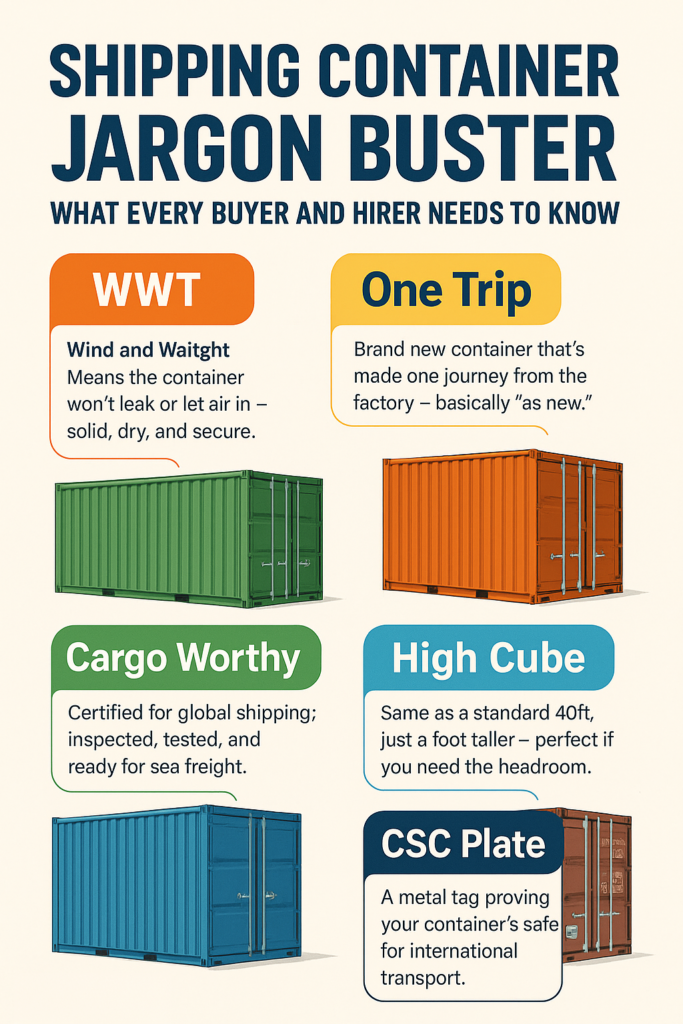
For buyers and hirers in the UK market these terms help distinguish between condition, suitability, compliance, cost, and value. For instance, a “one-trip” unit is likely to fetch a higher price or hire rate than a standard used unit. A “high cube” adds head-room (and cost). A “CSC plate” means it’s certified for international transit. And “WWT” means you won’t get leaks or condensation problems. Mis-understanding what you’re signing up for can mean extra costs, maintenance headaches, or unsuitability for your project.
2.2 Key terms demystified
Here’s a breakdown of the most common terms you’ll encounter when buying or hiring a shipping container:
WWT (Wind and Watertight)
This means the container has been sealed, checked for leaks or holes, doors and seals functioning properly, and is considered suitable for storage or shipping in exposed conditions. A specialist site defines WWT as a key condition before hire. Highway Logistics+2Container Container+2
One-Trip Container
A “one-trip” unit is typically brand new from manufacture, shipped once (usually from Asia to a port) and then sold/hired in the UK. It has minimal wear and less rust, so it commands a premium. Users looking for top condition or high-end use will want one-trip.
High Cube (HC)
This is a container that is taller than standard (typically ~9′6″ (2.9 m) internal height versus 8′6″ (~2.6 m)). This extra head-room is ideal if you’re stacking internal shelves, storing tall items, doing conversions (workshop, office) or simply want more cubic capacity.
TEU (Twenty-Foot Equivalent Unit)
A standard measurement in shipping: 1 TEU equals a 20ft container. A 40ft container is 2 TEU. Useful when calculating capacity, pricing, or transport logistics. Cubus Web site+1
MGW / Tare Weight / Payload
- Tamble term: Tare Weight – the weight of the empty container.
- MGW – Maximum Gross Weight – the total weight of the container plus its contents allowed for transport. Billie Box Ltd
These are important if you’re transporting, stacking, or planning internal load-outs (shelving, equipment, etc.).
ISO 6346 Marking / Intermodal / Intermodal Container
The standard code that identifies the container: owner prefix, serial number, check-digit, size type etc. Wikipedia “Intermodal” means the container is designed for multiple transport modes (ship, rail, road) without unpacking. Billie Box Ltd
Container Condition Terms: Cargo Worthy / Wind & Water Tight / Ex-Shipping / New One Trip
- “Cargo Worthy” or “CW” implies the container meets the minimum condition for sea freight.
- “WWT” as above for storage suitability.
- “Ex-Shipping” means previously used for shipping, probably several trips, at lower cost.
- “New One Trip” as above.
2.3 Why it matters whether you’re buying or hiring
If you’re hiring from Cubus Containers (or similar UK providers) the condition, terms and spec matter differently than if you buy. For hire: you’ll pay rental/month, you may cover delivery/collection costs, you may have minimum hire period, you’re not committing capital upfront but you don’t own the asset. For purchase: you pay once, you may handle maintenance, you can resell, but upfront cost is higher and you take responsibility for condition and certification.
Many hire providers in the UK offer flexible terms (see TITAN Containers) to adapt to short-term versus long-term hire. TITAN Containers UK+1
2.4 Common mistakes & how to avoid them
- Accepting “just any” used container: Without checking WWT, CSC plate, condition you may end up with leaks, rust or a unit not allowed for your intended use.
- Underestimating delivery / placement complexity: Flat-site required? Obstructions? Accessibility? Delivery/collection charges vary. Secure Stores
- Over-paying for needless feature: Do you really need one-trip or high cube, or will a standard unit suffice?
- Not clarifying hire terms: Minimum hire period? Return/collect costs? Damage policy? Secure Stores
- Ignoring resale or upgrade value: If buying, consider future value; hire you may move on easily but cost may accumulate.
2.5 Buying vs Hiring – quick comparison
Buying
- Pros: Ownership, asset value, no recurring hire cost, full control.
- Cons: Higher upfront cost, maintenance/responsibility, possible spec overkill, less flexibility.
Hiring
- Pros: Lower upfront cost, flexibility, provider handles some maintenance, good for temporary or semi-permanent use.
- Cons: Recurring cost, you don’t own it, may be less choice in size/spec, may incur delivery/collection fees, committed to hire period.
2.6 How to speak confidently to your supplier
When talking to a supplier such as Cubus Containers, you’ll want to ask:
- “Is this unit WWT and has it been inspected recently?”
- “Does it carry a valid CSC plate?”
- “What is the internal height – is it high cube?”
- “How many trips has it done – is it one-trip or ex-shipping?”
- “What condition is it in? Any visible rust, holes, weak doors?”
- “What size are you offering? 20ft or 40ft, and what internal cubic capacity?”
- “What are the delivery/collection charges and what’s the minimum hire period?”
- “What are the payment terms for hire or purchase? Is VAT included?”
- “If buying, is there resale support or buy-back scheme offered?”
As one provider advises: check “What condition is the container in?”, “Delivery included?”, “Terms of hire agreement?” etc. Secure Stores
2.7 Additional tech and compliance notes
Beyond jargon, keep an eye on technical and regulatory features:
- Floor type: marine-treated plywood vs bamboo vs standard timber. Billie Box Ltd
- Ventilation / condensation control: especially if storing sensitive items. Billie Box Ltd+1
- Delivery site prep: level ground, overhead cables, hi-ab access.
- Insurance / liability: if conversion or high value contents.
- Modifications: doors, windows, shelving: may affect condition and resale/hire value.
3. Case Study: How Speaking the Lingo Saved the Day for a UK Construction Site
At a mid-sized construction project in the Midlands, the site manager realised that the “container” he’d ordered for tool and materials storage was leaking, rusting and only 8′6″ internal height — the shelving they’d planned wouldn’t fit. His contract described it as “used container” with no mention of “WWT” or “high cube”.
He called in Cubus Containers, and did the right thing: specified he needed a 40ft WWT high cube one-trip container with CSC plate, at hire for 6 months. Because he used the jargon properly:
- They delivered a unit that was genuinely WWT (no leaks), recently made (one-trip), taller internal height (high cube), and certified.
- The shelving system fit perfectly; storage space was optimised; delivery and collection costs were clear.
- Because the manager understood the terms he avoided the mistake of a cheaper but inadequate container (which would have cost extra via repairs, downtime, and re-hire).
- The hire agreement they signed included clear minimum period, collection terms and condition checks (as recommended by industry sources). Secure Stores
In short: by knowing the jargon and asking the right questions, the manager saved cost, stress, and schedule disruption.
Alright, you’re now officially capable of saying things like “I need a 20ft WWT high cube one-trip with CSC plate and MGW 30,480 kg please” without blinking. Jargon dominance achieved.
But beyond the clever phrasing, the real goal is: you know what to ask, what to check, and why it matters. Whether you’re buying or hiring, that means you’ll be more likely to get exactly the right container for the job — one that fits your budget, your timeline, your site logistics and your long-term plan.
In a market where things like condition, spec, delivery logistics and contract terms can vary wildly, being armed with the right language makes you a savvy buyer or hirer — not just a confused recipient of a big metal box.
Next time you speak to your supplier, you’ll not only know what the words mean — you’ll know how they impact your project. And that means fewer surprises, less risk, and better outcomes.
Ready to talk containers (without the BS)? Get in touch with Cubus Containers today for a no-nonsense quote and expert guidance on buying or hiring the right unit for your project.