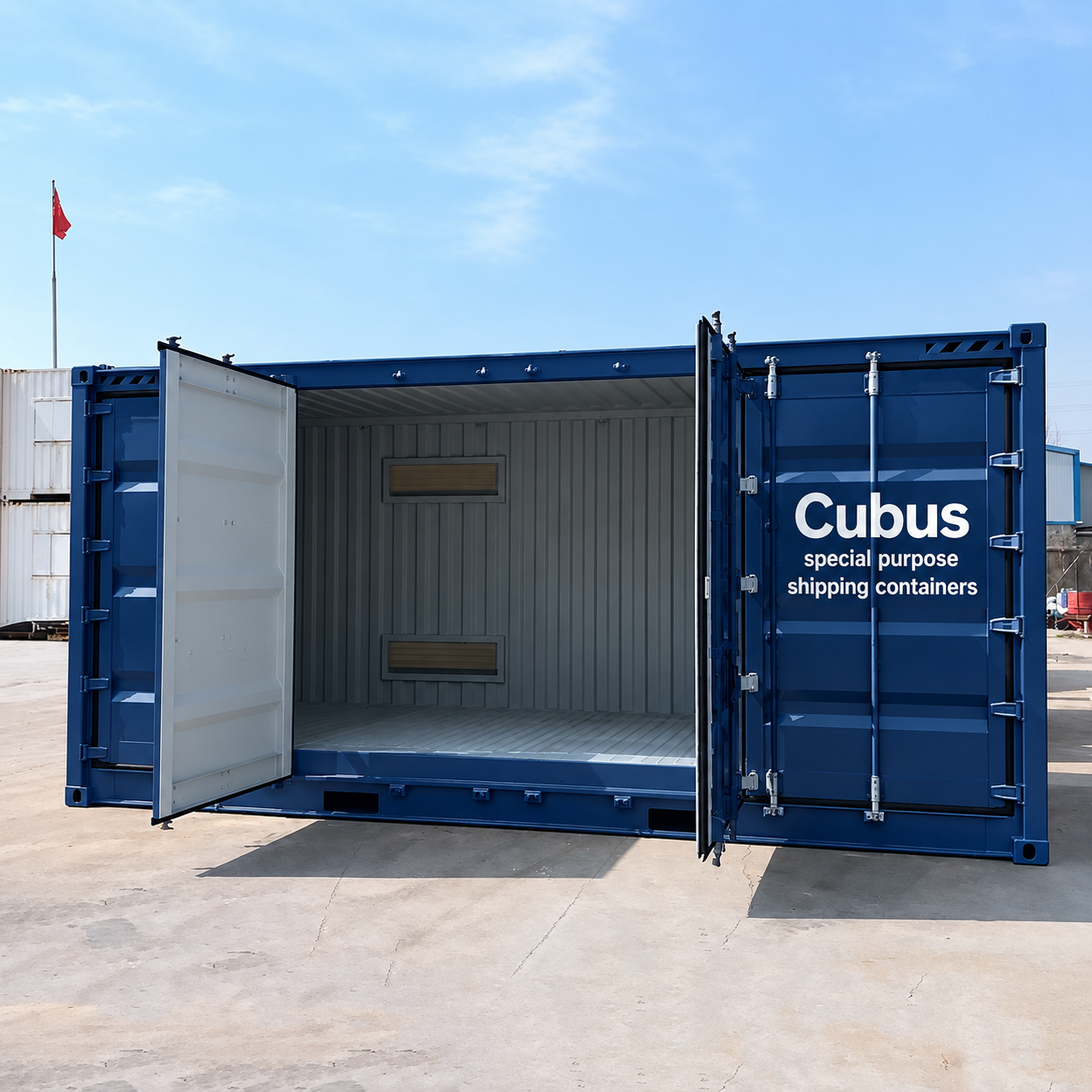
What happens when a standard shipping container is almost right for the job – but not quite?
For most storage requirements, a traditional 20ft or 40ft shipping container does the job brilliantly.
It is secure.
It is robust.
It is relatively simple.
And, provided you choose the right condition, it keeps the British weather where it belongs.
Outside.
But not every storage problem is standard.
Sometimes you need access from both ends.
Sometimes opening two doors at the back isn’t remotely convenient because the thing you want is buried approximately 37 boxes deep.
Sometimes you need to load from above.
Sometimes you’re storing food, pharmaceuticals or other temperature-sensitive goods.
And sometimes your site has so little access that delivering a conventional shipping container would require demolishing the neighbour’s garage.
That’s where special purpose shipping containers come in.
Cubus Containers supplies specialist containers across the UK, with units available in sizes from 6ft through to 45ft, depending on container type and availability. Containers are available for sale or hire, with new and used options available across the wider range.
The important thing isn’t choosing the most unusual container.
It’s choosing the one that solves your particular problem.
FEATURED QUOTE
“A special purpose container isn’t special because it looks different. It’s special because it removes a problem a standard container can’t.”
What Is a Special Purpose Shipping Container?
A special purpose container is essentially a container designed or adapted for a more specific use than ordinary enclosed dry storage.
The standard general-purpose shipping container remains the backbone of containerised freight. It is enclosed, secure and designed to handle general dry cargo.
Specialised designs change that basic formula.
They might provide:
- Doors at both ends
- Full side access
- Refrigeration
- An opening roof
- Additional internal height
- Compact dimensions
- Easier loading
- A layout specifically suited to a conversion or operational requirement
In commercial terms, this can make a substantial difference.
A business doesn’t really care how impressive the engineering terminology sounds.
It cares whether employees can get to the stock.
Whether machinery fits through the opening.
Whether frozen goods stay frozen.
Whether the container fits on the site.
Whether it actually solves the problem.
Why Not Just Modify a Standard Container?
You can.
Shipping containers are wonderfully adaptable.
Doors, windows, partitions, shelving, electrical systems, ventilation and insulation can all be added to appropriate units.
But there are occasions where buying a purpose-designed container makes far more sense than heavily modifying a standard one.
Suppose you need to access stock from both ends.
You could buy a standard container and install another set of cargo doors.
Or you could simply buy a tunnel container, which already has doors at both ends.
Likewise, if you routinely need full-length access to stored goods, installing multiple door openings into a standard unit may involve considerably more structural modification than simply using a purpose-built side-opening container.
Good container buying is about starting with the closest possible solution.
Not buying the wrong box and then spending money trying to persuade it to become the right one.
Tunnel Shipping Containers
What Is a Tunnel Container?
A tunnel container – sometimes called a double-door shipping container – has cargo doors at both ends.
Instead of one entry point, you effectively have two.
It sounds like a small difference.
In practice, it can completely change the way a container works.
Cubus describes tunnel containers as particularly useful where goods require continuous access, with the double-door arrangement also making them suitable for conversion into separate sections.
Why Are Tunnel Containers Useful?
Imagine a conventional 40ft shipping container full of stock.
The item you need is right at the front.
Perfect.
Now imagine it’s at the other end.
Less perfect.
You may have to unload substantial amounts of stock simply to reach it.
With doors at both ends, you can organise the container far more intelligently.
Frequently used items can be placed near either entrance.
Stock rotation becomes easier.
Different categories can be accessed from different ends.
And there are conversion possibilities too.
Dividing a Tunnel Container
One particularly useful application is creating two separate storage areas within the same container.
Install a secure internal partition and you can potentially create two individually accessible compartments.
For example:
- Two departments sharing one container
- Separate tool and material stores
- Different contractors using the same unit
- Sports clubs separating different equipment
- Landlords or storage operators creating two storage areas
One container.
Two entrances.
No climbing over somebody else’s lawnmower to reach your equipment.
Who Might Use Tunnel Containers?
Tunnel containers can work well for:
- Construction sites
- Retail stock
- Equipment hire companies
- Warehousing
- Schools
- Sports clubs
- Farms
- Workshops
- Self-storage
- Container conversions
Where frequent access matters, that second set of doors can be worth considerably more than it initially appears.
Side-Opening Shipping Containers
What Is a Side-Opening Container?
A side-opening shipping container takes accessibility rather more seriously.
In addition to doors at one end, large doors open along the side of the container.
Cubus supplies side-opening units designed to make storing and accessing larger items easier, giving users much wider access than conventional end doors provide.
Instead of having an opening around eight feet wide, you can expose a substantial part of the container’s length.
That’s useful when your cargo has absolutely no interest in fitting neatly through standard doors.
Why Side Access Matters
Suppose you’re storing:
- Palletised stock
- Furniture
- Event equipment
- Long materials
- Machinery
- Exhibition equipment
- Retail displays
- Construction materials
With ordinary end-loading, everything needs to move through a relatively narrow opening.
A side-opening container changes the workflow.
Forklifts can access cargo from the side.
Large items can be positioned more easily.
Stock doesn’t necessarily have to be arranged according to what needs to come out first.
And employees spend less time entering a dark steel tunnel looking for something that is inevitably behind the heaviest pallet.
Side-Opening Containers for Retail
These containers are also particularly attractive for conversions.
Open the side and suddenly the container becomes a potential:
- Pop-up shop
- Exhibition stand
- Bar
- Food unit
- Ticket office
- Event kiosk
- Showroom
The large opening naturally creates a customer-facing frontage.
Close the doors at the end of the day and the contents remain protected within the steel container.
That combination of access and security is difficult to replicate with a traditional gazebo and a determined expression.
Open-Top Shipping Containers
When the Problem Is Height
Sometimes the cargo fits within the container’s length.
It fits within the width.
But unfortunately, it has completely ignored the height restriction.
That’s where open-top containers come in.
Rather than having a conventional steel roof, open-top shipping containers use a removable covering arrangement, typically allowing cargo to be loaded vertically.
Cubus positions open tops specifically for oversized loads and cargo that is difficult to load conventionally.
Major shipping lines similarly describe open tops as being designed for over-height or awkward cargo, with removable tarpaulin-style roof systems allowing access from above.
Loading From Above
This is the major advantage.
Some cargo is far easier to lower into a container using a crane than manoeuvre through the cargo doors.
Think:
- Industrial machinery
- Large engineering components
- Heavy equipment
- Construction products
- Oversized manufacturing equipment
- Unusual fabricated structures
A crane can lift the item vertically and position it directly inside.
Once loaded, the top can be appropriately covered and secured.
Open Tops for Storage
Open-top containers aren’t exclusively a freight product.
They can also have specialist storage uses where regular crane access is required.
However, customers need to understand that an open top behaves differently from a conventional enclosed container.
If you’re storing boxes of office paperwork for three years, the ability to remove the roof is unlikely to be the benefit you’ve been waiting for.
As always, choose the container around the application.
Refrigerated Shipping Containers
What Is a Reefer Container?
Refrigerated shipping containers – commonly called reefers – are one of the most technically specialised container types.
Unlike a standard dry container, a reefer includes equipment designed to maintain controlled internal temperatures.
International shipping guidance commonly identifies refrigerated containers as being designed for temperature-sensitive goods including food and pharmaceuticals.
They are essentially robust, insulated, mobile cold-storage units.
And that’s useful far beyond ships.
What Can Refrigerated Containers Store?
Applications can include:
- Frozen food
- Chilled food
- Catering stock
- Ingredients
- Beverages
- Pharmaceuticals
- Certain chemicals
- Floristry products
- Temperature-sensitive commercial stock
They’re commonly used when businesses need extra cold-storage capacity without immediately constructing another refrigerated building.
Seasonal Refrigerated Storage
This can be particularly useful around peak periods.
A food business may have sufficient cold storage for normal operations but suddenly need significantly more capacity before Christmas.
An events company might need temporary refrigerated storage for a major festival.
A catering business might require extra space for several months.
Rather than permanently expanding the building to accommodate an occasional peak, a refrigerated container can provide flexible additional capacity.
Reefer Containers Need Power
There is one extremely important detail.
The refrigeration machinery requires an appropriate electricity supply.
It sounds obvious.
Yet assuming a refrigerated container will somehow keep itself cold through strength of character is unlikely to end well.
Before installation, consider:
- Electrical requirements
- Site supply
- Location
- Ventilation around the refrigeration machinery
- Access
- Temperature setting
- Monitoring
- Backup arrangements where critical stock is involved
For high-value or highly sensitive products, temperature control should be considered as part of a wider risk-management system rather than simply plugging the unit in and forgetting about it.
Flat-Pack Containers
When Access Is the Actual Problem
What happens if you desperately need secure storage – but getting a conventional shipping container onto the site is virtually impossible?
Perhaps there’s:
- A narrow passage
- Restricted gateway
- Building access
- A small garden
- A courtyard
- Limited lifting access
- Overhead obstructions
A 20ft steel container is not known for its ability to squeeze through a standard doorway.
Flat-pack storage containers provide another option.
They can be transported in sections and assembled in position.
That’s particularly useful where vehicle or crane access prevents delivery of a traditional container.
Where Flat-Pack Containers Work Well
Applications can include:
- Schools
- Domestic sites
- Allotments
- Community organisations
- Building courtyards
- Sports grounds
- Restricted commercial sites
The crucial benefit isn’t that they’re more container-ish than conventional containers.
Quite the opposite.
They solve situations where conventional container delivery is impractical.
Small Shipping Containers
Sometimes 20ft Is Simply Too Much
The shipping industry loves 20ft and 40ft containers.
Your site might not.
Perhaps you need secure storage but only have ten feet available.
Or eight.
Or six.
Cubus’s wider container range includes specialist and small-container options, with the specialised range advertised from 6ft up to 45ft depending on specification and availability.
Small containers can be remarkably useful for:
- Schools
- Clubs
- Small businesses
- Tools
- Maintenance equipment
- Groundskeeping equipment
- Small construction sites
- Domestic storage
- Archives
- Site consumables
Why buy 20ft if you only need 8ft?
Yes, growth matters.
But so does not filling half your premises with empty steel.
High-Cube Containers
High-cube containers aren’t always grouped under specialist containers, but they’re worth considering whenever standard height becomes restrictive.
A typical high-cube container is approximately one foot taller externally than a standard dry container. Industry container specifications commonly identify 40ft high cubes as a major general-purpose option.
That extra height can make a surprisingly large difference.
It provides:
- Greater internal volume
- Better stacking potential
- More comfortable headroom for conversions
- Space above racking
- Greater flexibility for bulky cargo
If you’re considering a workshop, office or other conversion, high cube may be worth discussing before automatically ordering a standard-height unit.
Special Purpose Containers for Conversions
This is where specialised containers become particularly interesting.
Starting with the right container can reduce the amount of structural modification required later.
For example:
Retail conversion
A side-opening container already provides the large customer-facing opening you probably want.
Two-unit storage conversion
A tunnel container already provides independent access from both ends.
Workshop
A high-cube container may provide better working height.
Cold store
A reefer already incorporates insulation and refrigeration equipment designed for controlled-temperature use.
Restricted-access site
A flat-pack unit may get somewhere a conventional container simply cannot.
The question isn’t:
“What can we turn a container into?”
We’ve already established the answer is almost anything.
The better question is:
“Which container gives us the best starting point?”
Buy or Hire a Specialist Container?
You don’t necessarily have to own one.
Cubus offers specialised containers for sale or hire, allowing customers to choose according to how long they need the equipment.
Buying May Make Sense When:
- The requirement is long term
- You expect regular use
- You’re planning significant modifications
- You want complete control over the unit
- You have a permanent site
Hiring May Make Sense When:
- The requirement is temporary
- You have seasonal demand
- It’s linked to a specific project
- You don’t want to commit capital to ownership
- You need short-term additional capacity
Consider the entire expected duration.
Hiring something for several years may not provide the best long-term value.
Equally, buying a refrigerated container for a three-week event might be slight overkill.
New or Used?
Specialist units may also be available in new and used condition depending on type, stock and specification.
A used container can provide excellent value where appearance is secondary.
A new or one-trip unit may make more sense for:
- Premium conversions
- Customer-facing installations
- Sensitive storage
- Long-term ownership
- Projects where cosmetic appearance matters
Once again, don’t confuse cosmetic perfection with functional suitability.
A container can have dents and still solve the problem brilliantly.
How Do You Choose the Right Special Purpose Container?
Start by forgetting containers for a moment.
Describe the problem instead.
Ask:
What are you storing?
Dimensions, weight and characteristics matter.
How will you load it?
By hand?
Forklift?
Pallet truck?
Crane?
How frequently will you access it?
Every hour?
Once a week?
Twice a year?
Where will the items be positioned?
If stock right at the far end needs constant access, ordinary rear doors may prove frustrating.
Does the cargo require temperature control?
If yes, you may need a reefer or another engineered solution.
Does it fit through standard container doors?
If not, side-opening or open-top designs deserve consideration.
How much site space is available?
A 40ft unit is fairly difficult to ignore once it arrives.
Can a conventional container actually reach the site?
If not, flat-pack may be the sensible answer.
Are you planning a conversion?
Think about the final design before buying the steel shell.
Case Study: A Business With the Wrong Storage Problem
Imagine a growing event company.
It stores:
- Folding bars
- Furniture
- Signage
- Exhibition displays
- Lighting equipment
- Gazebos
- Refrigeration equipment
- Palletised consumables
The company initially buys a conventional 40ft shipping container.
Excellent value.
Secure.
Wind and Watertight.
Completely suitable.
Except for one irritating detail.
Nobody can get to anything.
The furniture needed for tomorrow’s event is halfway down the container.
A lighting flight case is at the back.
The pallet needed first was loaded second.
The team spends an extraordinary amount of time moving equipment simply to reach other equipment.
The problem isn’t storage capacity.
The container is large enough.
The problem is access.
A side-opening container changes everything.
With the doors open along the length, items can be grouped into defined areas.
Lighting here.
Furniture there.
Bar equipment at one end.
Displays at another.
Forklift access becomes easier.
Individual items no longer need to pass through every other item on their way in and out.
The company hasn’t gained more square metres.
It has gained usable storage.
And that’s the important distinction.
A cheaper container isn’t cheaper if it wastes hundreds of staff hours every year.
The specialist container costs more.
But it solves the actual problem.
Why Cubus Containers?
Cubus Containers supplies both standard and specialised shipping containers nationwide, supported by eight well-stocked UK depots. The company’s specialist range includes tunnel, refrigerated, side-opening, open-top and flat-pack solutions, with containers available for sale or hire.
That range matters because there isn’t a single “best shipping container”.
There is only the best container for the job.
Sometimes that’s a standard used 20ft container.
Sometimes it’s a pristine 40ft high cube.
And sometimes you need a steel box with doors almost everywhere.
Don’t Make Your Storage Fit the Container
This is perhaps the biggest lesson.
Businesses often begin with:
“We need a 20ft shipping container.”
Do you?
Or do you need secure storage with easy forklift access?
Do you need refrigeration?
Do you need two independent compartments?
Do you need overhead loading?
Do you need storage somewhere a 20ft container cannot physically reach?
The container should adapt to the requirement.
Not the other way around.
Because there is absolutely no prize for buying a standard container and then spending the next ten years being irritated by it.
Find the Right Specialist Container
Whether you’re looking for a tunnel container, refrigerated container, side-opening container, open-top shipping container, flat-pack unit or another specialist storage solution, talk to Cubus Containers about what you’re actually trying to achieve.
Tell us:
- What you’re storing
- How big it is
- How heavy it is
- How you’ll load it
- How often you’ll access it
- Where the container is going
- How long you need it
- Whether you want to buy or hire
From there, choosing the right container becomes considerably easier.
Because sometimes the standard steel box is perfect.
And sometimes the doors are simply in the wrong place.
Talk to Cubus Containers
Cubus Containers supplies special purpose shipping containers across the UK, alongside standard 20ft, 40ft and small container options.
With nationwide stock and specialist units available for sale and hire, our team can help you choose the right container for your site, business and storage requirements.
Tell us the problem. We’ll help you find the box that solves it.