Need better access to your container, or are you just planning to spend the next three years climbing over stock like a caffeinated squirrel in a steel cave?
Introduction
Most people start their container search by asking a very sensible question: what size container do I need? That is fair. Size matters. There, we said it. But once you have decided between a 10ft, 20ft or 40ft unit, the next question is often the one that saves the most shouting, swearing and forklift gymnastics: how do you actually get into the thing?
A standard shipping container is brilliant, secure and dependable. It is also, by design, a long steel box with doors at one end. That works perfectly if you are storing items in a neat sequence, rarely accessing the back, or loading everything in one organised operation. Sadly, real life is not always arranged like a brochure. Real life is muddy yards, awkward plant machinery, seasonal stock, event equipment, pallets that need to come out in the wrong order, and someone saying, ‘Can you just grab the item right at the back?’ Of course it is at the back. It is always at the back.
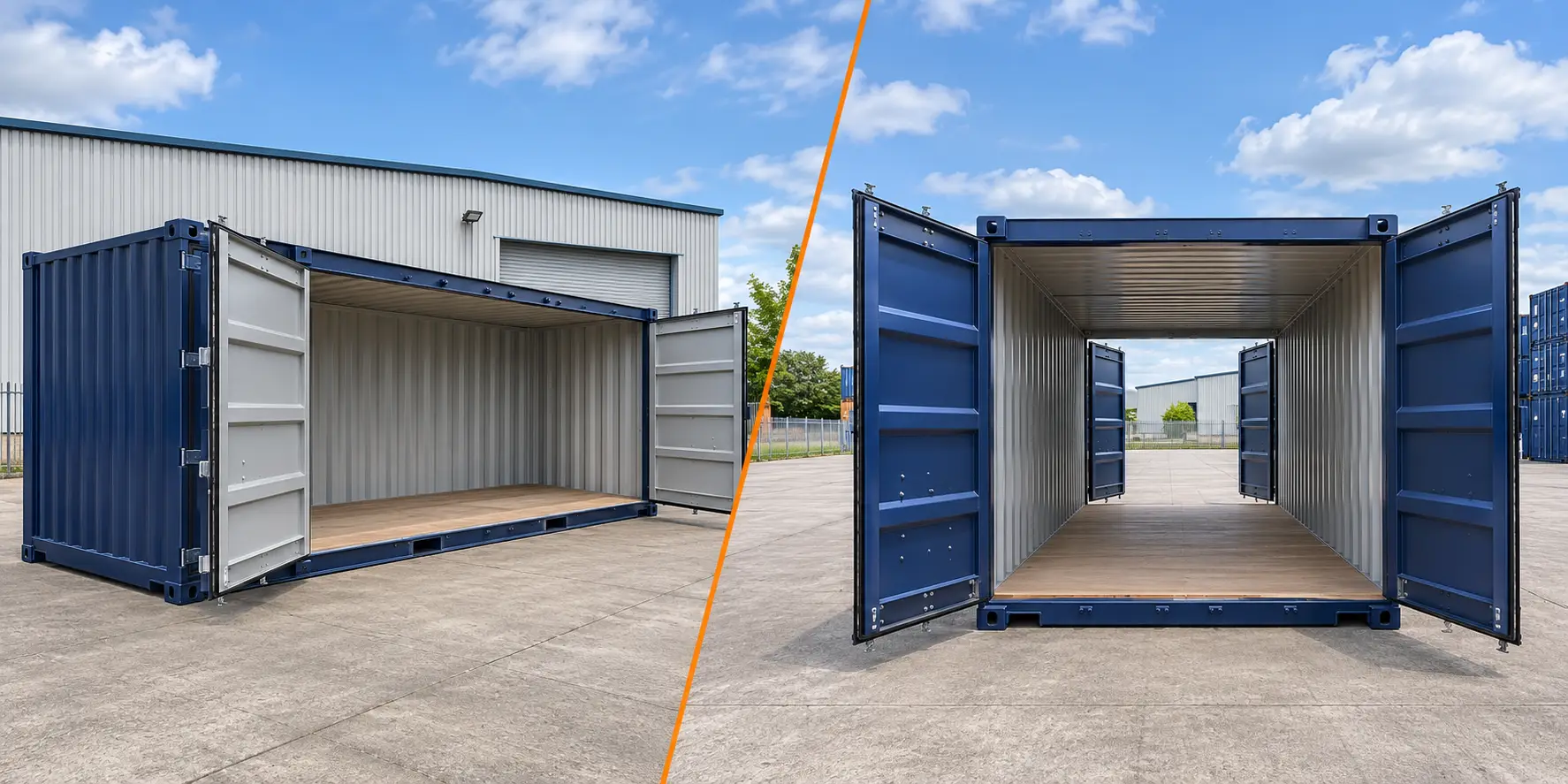
That is where side opening containers and tunnel containers earn their keep. Both solve access problems, but they solve different access problems. A side opening container gives wide, full-length access along the side, making it ideal for bulky items, retail-style layouts, loading from the side, conversions and fast visibility of everything inside. A tunnel container, also known as a double door container, has doors at both ends, making it ideal for stock rotation, two-way access, partitioning, site walk-throughs and avoiding the classic ‘empty half the container to reach one thing’ fiasco.
This guide compares side opening vs tunnel containers properly, without the usual sales fog machine. We will look at how they work, where each one makes sense, where each one can be overkill, and how to choose the right access configuration before you buy or hire the wrong steel rectangle and make it everyone’s problem.
Featured quote: “The best container is not always the biggest one. It is the one that lets your team reach what they need without turning every job into an archaeological dig.”
The Real Problem Is Not Storage. It Is Access.
Businesses often think of containers as storage first. That is understandable, because containers are excellent at keeping things secure, weather-resistant and out of the way. But once the container lands on site, the daily pain point is rarely the steel itself. It is access. Who needs to get in? How often? With what equipment? From which direction? And how much space do they have around the unit?
A standard container is simple. Doors at one end. Load from the front, stack towards the back, shut the doors, job done. It is the Ford Transit of the container world: practical, honest and not pretending to be a champagne bar in Shoreditch. But its strength is also its limitation. The deeper the container, the more planning is required. If the item you need is behind twenty other items, the container has technically stored it beautifully. It has also hidden it like a steel dragon guarding treasure.
Access-led container selection flips the question. Instead of asking only what will fit inside, you ask how the contents will move in and out. That matters for construction sites, farms, workshops, events companies, schools, retail operations, self-storage, sports clubs, manufacturing units and anyone who has ever lost half a morning trying to drag one awkward item through a single end door.
Side opening containers and tunnel containers are both special purpose containers because they change the way the internal space behaves. They do not merely add doors. They change workflow. They can reduce loading time, improve visibility, reduce manual handling strain, make stock rotation easier and create new conversion possibilities. They are not magic, obviously. They are still containers, not interns with unlimited enthusiasm. But when specified properly, they remove some of the most common frustrations associated with standard units.
What Is a Side Opening Container?
A side opening container, sometimes called a full side access container or open-side container, is designed so that one long side can be opened, usually with bi-fold or concertina-style doors. Many versions still include the normal end doors, but the defining feature is the wide side access. Instead of working through an 8ft end opening, you can open the side and reach the full length of the load space.
That sounds like a small change until you use one. Suddenly you are not feeding awkward objects into a long metal tunnel. You are loading from the side, positioning items directly where they need to sit, and seeing most of the contents without performing a full expedition. For businesses storing long, wide, fragile or frequently moved items, this can be the difference between a smooth morning and a yard full of people pointing at the forklift like it has personally betrayed them.
Side opening containers are particularly useful when the items being stored are difficult to manoeuvre through standard end doors. Think exhibition stands, shop fittings, construction materials, machinery parts, staging, barriers, large signage, timber, pipework, plant attachments, boxed goods, event furniture or anything that is annoying enough to deserve its own meeting. Because the side opens up, loading can be more direct and less dependent on dragging, twisting or re-stacking.
They are also popular for conversions. A side opening container can become a pop-up shop, bar, service counter, workshop, display unit, bike store, equipment hub or hospitality space. When the side doors open, the container stops feeling like a sealed storage box and starts behaving like a usable room, frontage or access point. That is why designers, event operators and commercial users often look at side openers when appearance and customer flow matter as much as storage.
What Is a Tunnel Container?
A tunnel container is a container with double doors at both short ends. It is also commonly called a double door container. Open both ends and, rather unsurprisingly, you have a tunnel. The naming committee clearly had a big lunch that day.
The main advantage is two-way access. You can load from either end, retrieve goods from either end, rotate stock more easily, and avoid burying essential items at the far end of the container. If your site layout allows access from both ends, a tunnel container can make a standard-length unit feel far more practical.
Tunnel containers are often used where goods are loaded in sequence, where teams need frequent access to different sections, or where the container may be split into two separate compartments. Add a partition wall in the middle and a single tunnel container can become two smaller lockable storage spaces, each with its own door. That can be useful for sites with multiple trades, schools with shared equipment, farms separating feed from tools, or businesses that want one container to do two tidy little jobs instead of one chaotic big one.
Tunnel containers also work well for event sites, temporary walkways, secure entrance routes and operational zones where a through-route is useful. They do not offer the same broad side access as a side opening unit, but they solve a different problem: they reduce the penalty of depth. In a standard unit, the back can become a storage black hole. In a tunnel container, the back has doors too. Very civilised.
Side Opening vs Tunnel Containers: Quick Comparison
| Feature | Side Opening Container | Tunnel Container |
| Main access point | Full or near-full access along one long side | Double doors at both short ends |
| Best for | Wide, bulky, awkward, display or conversion-led use | Two-way access, stock rotation, partitioned storage and faster retrieval |
| Site space needed | Needs clear working space along the side | Needs clear access at both ends |
| Loading style | Side loading with good visibility across the unit | End loading from either direction |
| Conversion potential | Excellent for pop-ups, bars, retail, workshops and display units | Good for divided stores, site walk-throughs and operational access |
| Typical limitation | Side doors need space to open and may cost more | Does not solve wide side-loading problems |
| Access personality | Opens the container like a shop front | Turns the container into a two-ended workflow |
When a Side Opening Container Makes More Sense
A side opening container is the better choice when width and visibility matter. If you need to see everything, reach everything, or load items without pushing them down the length of a container, side access is the star of the show. It is the container equivalent of opening the wardrobe doors rather than crawling through the sleeve of a coat.
For construction and trade users, side opening containers are excellent for materials that are long, heavy or awkward. Timber, metalwork, scaffold components, ducting, tools, temporary works equipment and packaged materials can be loaded by forklift or telehandler with fewer angles and fewer little dances of despair. Teams can also organise the unit into bays, making it easier to grab what they need without disturbing everything else.
For event companies, side opening containers can become highly practical equipment stores. Barriers, gazebos, staging, lighting rigs, signage, temporary flooring and furniture often need to be loaded and unloaded quickly. At events, speed matters because nobody wants to be the person still looking for cable ties while the public are arriving and the client is developing that special facial expression.
For retail and hospitality conversions, side opening containers are often the obvious route. A full side opening creates frontage. It can become a serving hatch, display area, shop entrance, workshop opening or customer-facing counter. Standard containers can be converted too, of course, but a side opener gives you a ready-made opening that naturally supports customer interaction and layout flexibility.
Side opening containers are also useful where the contents change regularly. If a team is constantly moving different items in and out, the ability to open the side and select items directly can save time. It can also reduce the temptation to create one giant heap of doom inside the unit. That may sound dramatic, but every yard manager knows the heap. The heap begins as ‘temporary’ and evolves into a permanent geological feature.
When a Tunnel Container Makes More Sense
A tunnel container is the better choice when the issue is not width, but sequence. If the problem is reaching items at the back, separating different users, improving first-in-first-out stock rotation or allowing access from both sides of a site, tunnel containers are wonderfully practical.
For stock storage, the two-door layout helps prevent the classic container problem where old stock gets trapped behind newer stock. Goods can be loaded from one end and removed from the other, depending on the operation. This can be especially useful for seasonal products, packaged goods, hire equipment, event stock, tools and materials that move in batches.
For construction sites, tunnel containers can serve multiple teams more neatly. One trade can access one end while another uses the other end, or the unit can be split with a partition to create two secure compartments. That is useful where space is limited and nobody wants two separate containers sitting there like oversized Monopoly hotels.
For schools, sports clubs and community sites, tunnel containers can be a clever way to separate equipment. One end can hold grounds maintenance tools, while the other holds sports kit. One end can be staff access, the other can be controlled access for volunteers. The key benefit is separation without necessarily needing separate units.
Tunnel containers also shine where the container forms part of a route. On events, festivals, worksites or controlled entrances, the through-access can be useful for movement, security and flow. They can be used as a secure pass-through, a checkpoint, a temporary corridor or a practical access route. A standard container blocks movement. A tunnel container can guide it. That is a subtle but important difference.
The Access Question: What Are You Actually Trying to Fix?
Before choosing between side opening and tunnel containers, it helps to name the irritation. Not the polite version. The real one. Are you tired of unloading half the container to reach one item? Are bulky objects getting damaged because they are being squeezed through end doors? Is your team wasting time hunting for things? Do you need a customer-facing opening? Do you need to divide one unit between users? Are forklifts approaching from the side or the end?
If your pain is ‘I need wide access’, choose a side opening container. If your pain is ‘I need access from both ends’, choose a tunnel container. If your pain is ‘my site is chaos and everyone keeps moving things’, you may need more than a container, but let us stay optimistic.
The best choice is normally obvious once you map the movement. Draw the site. Mark where the container will sit. Mark the direction vehicles, forklifts, staff and customers will approach from. Mark where the doors can open safely. Then ask what happens on a wet Tuesday when someone is in a rush. That is the real test. Container layouts that only work on a sunny day with a calm operator and a laminated plan are not layouts. They are fiction.
Also think about frequency. Occasional access is different from daily access. If the container is long-term archive storage, standard doors may be fine. If it is active site storage, special access can pay for itself in time saved. If it is part of a business operation or customer experience, the access design becomes even more important. You are not just buying steel. You are buying smoother movement.
Site Layout Matters More Than People Admit
Here is the glamorous bit nobody puts in the hero image: door clearance. A side opening container needs clear space along the side so the doors can open and people or machinery can work safely. A tunnel container needs usable access at both ends, otherwise one set of doors becomes decorative. Decorative container doors are a bold choice, but not usually a profitable one.
If your site is narrow, a tunnel container may be easier because the access remains at the ends. If your site has a wide yard or a side-loading route, a side opener may be brilliant. If the container is going against a wall, fence, hedge, building or suspiciously permanent pile of pallets, side doors may not make sense unless the opening side faces outward into a usable working zone.
Ground conditions matter too. Containers need a stable, level base. Access containers often involve more movement around the unit, so you need to think about safe footing, drainage, vehicle turning, forklift routes and whether the operator has enough room to work. A side opener placed beautifully on paper but badly in a muddy corner can quickly become the world’s most expensive steel cupboard.
Security should also be part of the site decision. More doors mean more access points to secure. That is not a reason to avoid specialist containers, but it is a reason to specify good locking systems, lockboxes where appropriate, and sensible site positioning. Make the container easy for your team to use, not easy for opportunists to browse like it is late-night retail therapy.
Loading and Manual Handling
Access is also a health and safety issue, although admittedly that phrase can make people mentally leave the room. Stay with it. Poor access encourages bad manual handling. If staff are dragging items down a long container, twisting awkwardly, climbing over stored goods or reaching around stacked materials, the risk of strain, damage and dropped items increases.
Side opening containers can reduce unnecessary handling because goods can be placed more directly. Instead of dragging items from the front to the back, operators can open the side and load into position. This is particularly helpful for heavy, wide or fragile items that do not enjoy being shoved around like a supermarket trolley with one bad wheel.
Tunnel containers reduce handling by making the back accessible. Rather than pulling everything out to reach one item, a team can open the opposite end. That sounds simple because it is. Many good operational decisions are simple. We just tend to discover them after buying the wrong thing first.
For businesses with frequent loading and unloading, the time and labour saving can be significant. Even a few minutes saved per access adds up over weeks and months. More importantly, smoother access lowers frustration. That matters because frustrated teams invent shortcuts, and shortcuts around heavy goods inside a steel box are rarely Nobel Prize material.
Cost, Availability and the Temptation to Over-Specify
Special purpose containers usually cost more than standard containers because they are less common and more complex. Side opening containers in particular can carry a premium due to their door systems and specialist build. Tunnel containers are often more widely available in common sizes, but availability still depends on condition, size, depot location and whether you are buying or hiring.
That does not mean specialist containers are expensive in the way a bad decision is expensive. A standard container may be cheaper on day one, but if it wastes labour every week, damages stock, slows loading, blocks workflows or needs replacing later, the saving can evaporate faster than a biscuit near a tradesperson’s brew.
The trick is not to buy the fanciest container. The trick is to buy the least complicated container that solves the actual access problem. Sometimes that is a standard unit with good shelving and sensible loading. Sometimes it is a tunnel container. Sometimes it is a side opening container. Sometimes it is a modified container designed around your exact use. The grown-up answer is annoyingly familiar: it depends. But it depends in very specific ways.
If the container will be used intensively, think in total cost of use rather than purchase price alone. How many people will access it? How often? What is their time worth? What happens if the wrong stock is hard to reach? What is the cost of damage? What is the cost of delays? The container is the visible cost. Inefficient access is the sneaky one wearing a fake moustache.
Conversion Potential: Shop Front or Split Store?
If you are considering a container conversion, the access configuration should be decided early. A side opening container naturally suits customer-facing and display-led conversions. It gives you a broad opening that can work as a shop front, counter, bar, serving point or open workspace. That makes it popular for events, food and drink, pop-up retail, product displays and mobile trade units.
A tunnel container is often better where the conversion needs separation or flow. You might create two rooms, two stores, a controlled entrance and exit, or a unit that works from both ends. It can be especially useful for operations where one side is public-facing and the other is staff access, or where two users need separate lockable areas.
For workshops, the answer depends on the working style. A side opener provides light, ventilation and easy access to benches or equipment. A tunnel container provides better through-flow and can keep dirty and clean zones apart. For welfare, site management or equipment hubs, either may work depending on the internal layout.
The important thing is to avoid treating doors as an afterthought. Doors define how people move, where counters sit, how stock is reached, how secure the unit feels and whether the final conversion works in real life. A beautiful container conversion with the wrong access is still wrong. It is just wrong with nicer cladding.
Which One Should You Choose?
Choose a side opening container if you need full-length access, side loading, visibility, display space or a customer-facing opening. It is the practical choice for bulky goods, awkward materials, event kit, retail conversions, workshops and any situation where end-only access feels like trying to post a sofa through a letterbox.
Choose a tunnel container if you need two-way access, faster retrieval from either end, stock rotation, partitioned storage or through-flow. It is the practical choice for construction sites, shared storage, hire stock, sports equipment, schools, events, farms and operations where the biggest enemy is the mysterious far end of the container.
Choose neither specialist option if your access needs are simple. Standard containers are popular for a reason. They are strong, secure, widely available and cost-effective. A specialist container should earn its place by solving a genuine operational problem, not by sounding clever in a meeting.
The best next step is to describe how the container will be used, not just what will go inside it. A good container supplier can then recommend the right size, condition, door configuration and delivery approach. That conversation is worth having before purchase, because once a container is on site, discovering that the doors open the wrong way is less ‘strategic procurement’ and more ‘steel-based regret’.
Case Study Example: The Events Company That Stopped Playing Container Tetris
Imagine an events company storing staging, lighting stands, temporary flooring, signage, crowd barriers, branded counters and enough cable to make an electrician quietly emotional. For years, they used a standard 40ft container at their yard. It was secure, weather-resistant and technically big enough. On paper, everything worked. In practice, the team spent too much time unpacking and repacking the same kit because the required items were rarely at the front.
The problem became obvious during peak season. One week they needed a small exhibition setup. The next week they needed outdoor barriers. Then they needed lighting truss, then flooring, then branded counters. Because the container loaded from one end only, stock had to be arranged around the next job. That meant constant reordering. When plans changed, the container became a puzzle designed by someone with a grudge.
Their first thought was to buy another standard container. More space would help, surely? Possibly. But the real issue was not volume; it was access. They did not need more steel. They needed to stop burying useful equipment behind other useful equipment. Very relatable. Very expensive. Very avoidable.
After reviewing the workflow, two options emerged. A tunnel container would allow kit to be accessed from both ends and could improve rotation. A side opening container would allow the team to open the long side, visually locate items and load bulky event equipment directly from the side. Because much of their equipment was wide, awkward and loaded by forklift, the side opening container made the strongest case.
The result was a much cleaner internal layout. The team created labelled zones for staging, flooring, signage, barriers and counters. Instead of dragging items through a narrow end access, they opened the side and picked directly from the right bay. Loading became quicker, stock checks became easier, and fewer items were damaged by being moved unnecessarily. The container did not make the events industry calm, because let us not be ridiculous, but it removed one regular source of chaos.
In a different version of the same business, a tunnel container might have been better. If the company had mostly boxed stock, sequential loading or two separate teams needing access from opposite ends, double doors could have solved the problem more cost-effectively. That is the point: the right container is not universal. It is operational. It depends on the shape of the work.
Conclusion
Side opening containers and tunnel containers both solve access problems, but they are not interchangeable. A side opening container solves the wide-access problem. A tunnel container solves the two-ended access problem. One opens the side of the story; the other gives the story a beginning and an end. Yes, that sentence is dramatic. It is still true.
If your team needs to reach bulky items, create a display frontage, load from the side or use the container as part of a conversion, side opening is often the sharper choice. If your team needs to reach goods from either end, rotate stock, divide the unit or create a through-route, a tunnel container may be the smarter answer.
Before choosing, think about the workday, not the brochure. Think about the rain, the forklift, the rushed collection, the seasonal stock, the person who needs ‘just one thing’ and the site layout that nobody remembered to measure. That is where the right access configuration proves its worth.
Containers are simple pieces of equipment, but simple does not mean one-size-fits-all. Choose the access properly and your container becomes an asset. Choose it badly and it becomes a steel cupboard full of lessons.
Need a container that is easier to load, easier to access and less likely to become the Bermuda Triangle of site storage? Speak to Cubus Containers about side opening containers, tunnel containers and special purpose container options built around how your business actually works.