Which shipping container size is right for your business: 20ft or 40ft?
Choosing between a 20ft and a 40ft shipping container sounds simple. One is twice as long as the other, so surely the answer is just “buy the biggest one you can afford”?
Not quite.
For many businesses, selecting the wrong container size leads to wasted money, inefficient storage, delivery headaches and, in some cases, a container that simply cannot be positioned where it needs to go. The best choice isn’t always the largest—it’s the one that matches your cargo, your site and your long-term plans.
Across the UK, 20ft and 40ft containers dominate the market because they offer an excellent balance of cost, practicality and availability. They’re used everywhere from construction sites and farms to warehouses, manufacturers, retailers and exporters. While they share the same width and height, their capabilities differ dramatically once you start loading pallets, machinery or stock.
Understanding those differences before you buy or hire can save thousands of pounds over the lifetime of the container.
In this guide we’ll compare both sizes, explain the real-world advantages of each, examine typical applications, discuss delivery considerations and help you decide which container offers the best value for your business.
Understanding Standard Shipping Container Sizes
The two most common ISO shipping containers are:
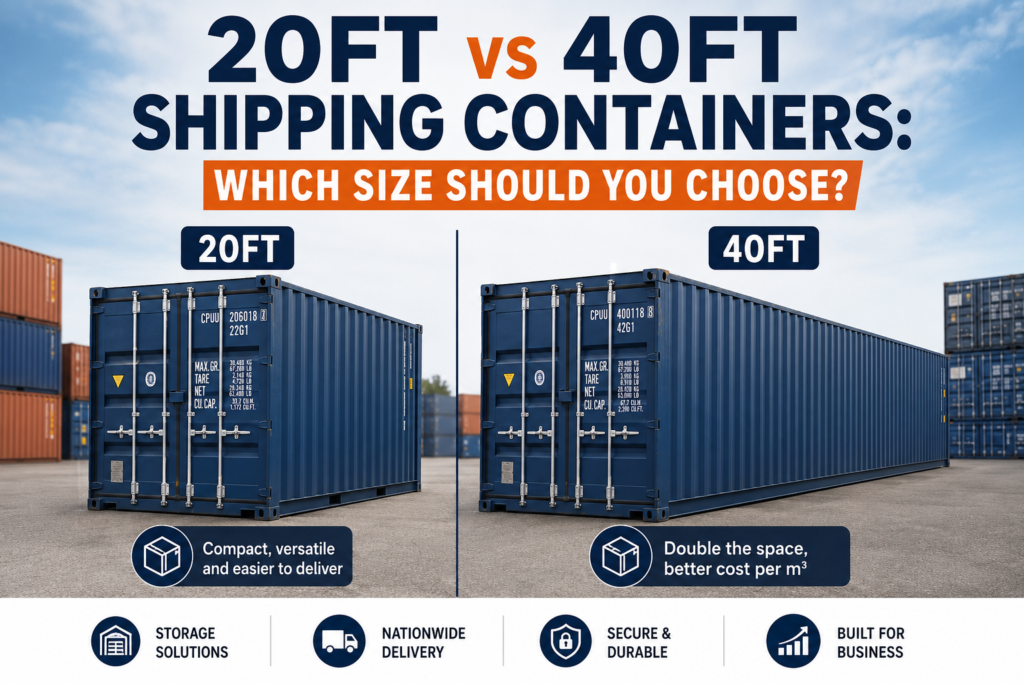
| Feature | 20ft Container | 40ft Container |
| External Length | 6.06m | 12.19m |
| External Width | 2.44m | 2.44m |
| External Height | 2.59m | 2.59m |
| Internal Volume | Approx. 33m³ | Approx. 67m³ |
| UK Pallets | Around 10 | Around 20 |
| Euro Pallets | Around 11 | Around 23–24 |
Although a 40ft container doubles the available volume, it doesn’t double every specification. Payload limits, delivery access and handling all become important considerations when moving larger containers.
The 20ft Container – The UK’s Most Popular Choice
If there were a “Swiss Army knife” of the container world, it would be the 20ft container.
It’s the most commonly purchased size because it offers substantial storage without demanding excessive space.
Typical uses include:
- Construction sites
- Agricultural storage
- Retail stock
- Manufacturing equipment
- Export cargo
- Household moves
- Archive storage
The footprint is manageable on most commercial premises and delivery is considerably easier than with larger units.
For many SMEs, a 20ft container provides all the storage they’ll ever need.
Advantages of a 20ft Container
Easier Delivery
The shorter length makes positioning much simpler.
Drivers can often access tighter industrial estates, farms and business parks where a 40ft unit would struggle.
This can reduce installation costs while avoiding expensive failed deliveries.
Better for Heavy Cargo
Many people assume bigger always means better.
In reality, dense cargo such as:
- Steel
- Engineering parts
- Machinery
- Building materials
often reaches weight limits long before filling the available space.
In these situations, a 20ft container is often the smarter choice.
Lower Purchase Price
Naturally, there’s less steel involved.
Purchase prices are generally lower than equivalent 40ft models, making them attractive for businesses watching capital expenditure.
Lower Transport Costs
Because the unit is easier to handle and transport, haulage costs can also be lower depending on the delivery location.
When Does a 40ft Container Make More Sense?
Sometimes volume really is king.
If your business stores lightweight goods, packaging materials or seasonal inventory, a 40ft container can deliver exceptional value.
Popular industries include:
- E-commerce
- Furniture
- Retail distribution
- Events
- Self-storage
- Warehousing
Rather than purchasing two smaller containers, one 40ft unit may provide a cleaner, more efficient solution.
Advantages of a 40ft Container
Double the Storage
A standard 40ft container provides approximately twice the internal volume.
This makes organisation much easier.
Many businesses install:
- Shelving
- Work benches
- Racking
- Lighting
- Power supplies
while still retaining excellent storage capacity.
Better Cost per Cubic Metre
Although the purchase price is higher, the cost per cubic metre of storage is often significantly lower.
Businesses planning long-term expansion frequently choose 40ft units because they provide room to grow without immediately requiring another container.
Excellent for Container Conversions
Container offices.
Workshops.
Cafés.
Retail units.
Training rooms.
All become much easier when you start with a 40ft shell.
The extra internal length offers far greater flexibility during conversion projects.
Delivery Considerations
This is where many buyers get caught out.
Buying the container is the easy part.
Delivering it isn’t.
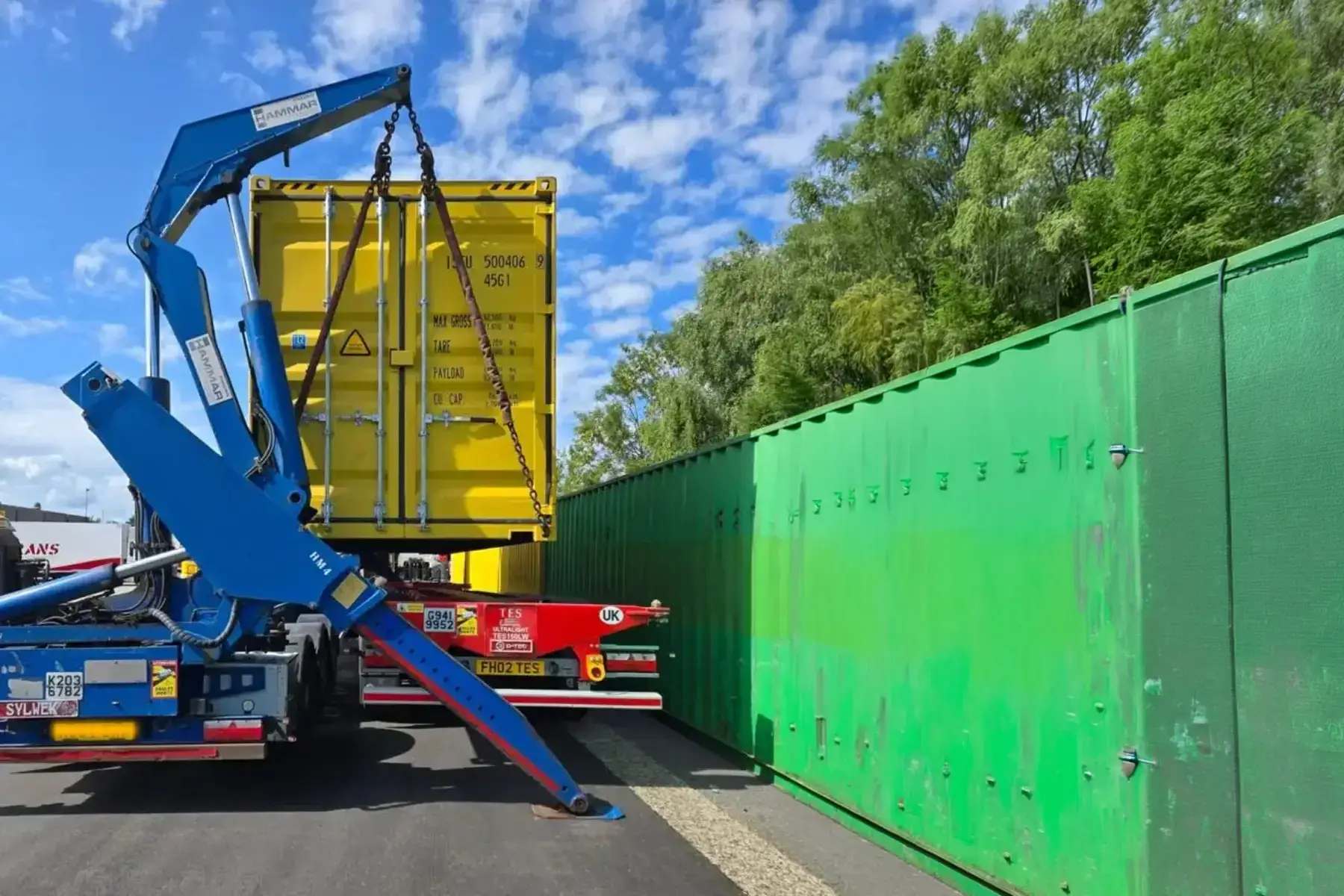
A 40ft container requires substantially more room for both the transport vehicle and unloading process.
Questions worth asking include:
- Is the access road wide enough?
- Are there tight corners?
- Are there overhead cables?
- Are there trees?
- Is the ground level?
- Can the delivery vehicle reverse safely?
- Is there sufficient clearance?
Professional delivery planning is just as important as choosing the container itself.
Which Container is Better for Shipping?
The answer depends on what you’re shipping.
Heavy cargo generally suits 20ft containers because maximum payload is reached before internal volume.
Lighter cargo often benefits from a 40ft container because more goods can be transported without approaching weight limits.
Exporters frequently calculate costs based on:
- Weight
- Volume
- Number of pallets
- Freight rates
- Destination handling
The cheapest container isn’t always the most economical shipping option.
Which Container is Better for Storage?
For most UK businesses, the decision comes down to available space.
Choose a 20ft container if:
- Site space is limited
- Access is difficult
- Storage needs are moderate
- Equipment is heavy
Choose a 40ft container if:
- You expect business growth
- You require warehouse overflow
- Goods are bulky but lightweight
- Future expansion is likely
Common Mistakes Buyers Make
Buying Too Small
Businesses often underestimate future storage needs.
Six months later they’re hiring another container.
Buying Too Large
Paying for unused space makes little financial sense.
A half-empty container still costs the same to buy and maintain.
Ignoring Delivery Access
One of the biggest mistakes.
If a container can’t reach the intended location, the delivery becomes expensive very quickly.
Forgetting Internal Layout
Think about how you’ll actually use the space.
Do you need:
- Shelving?
- A workbench?
- Walking space?
- Forklift access?
Internal planning often determines the correct size more than overall capacity.
Cost Considerations
Beyond the purchase price, consider:
- Delivery charges
- Ground preparation
- Security upgrades
- Lock boxes
- Ventilation
- Shelving
- Future relocation
Sometimes spending slightly more upfront saves substantial costs later.
Future-Proofing Your Investment
Many businesses keep containers for decades.
If expansion is likely within the next few years, investing in a larger unit can eliminate the need for future upgrades.
Conversely, businesses with limited yard space may gain more value from two strategically positioned 20ft containers than a single 40ft container.
Think beyond today’s requirements.
Plan for where your business will be in five years.
Final Thoughts
There is no universally “better” container.
Only the one that’s right for your operation.
A 20ft container remains the UK’s most versatile solution, offering excellent storage, easier delivery and lower costs.
A 40ft container excels when volume, organisation and long-term capacity matter most.
Before making a decision, consider your cargo, available space, access for delivery and future growth plans. Choosing the right size from the outset will save time, money and operational headaches for years to come.
Case Study: Choosing the Right Container Saved a Growing Retailer Thousands
A growing online retailer in the Midlands initially planned to purchase two 20ft containers to cope with increasing stock levels. On paper, this seemed like the logical choice because each unit could be positioned alongside an existing warehouse.
However, after a site assessment, it became clear there was sufficient space for a single 40ft container. The business mainly stored lightweight packaging, seasonal promotional materials and boxed consumer products rather than heavy equipment.
By choosing one 40ft container instead of two smaller units, the company reduced delivery costs, simplified site management and created a more efficient storage layout with dedicated aisles and shelving. Staff no longer needed to split inventory across two locations, improving stock picking times and reducing labour.
The retailer also avoided the future expense of adding another container as sales continued to grow. With double the storage volume in one unit and a lower cost per cubic metre, the investment paid for itself through improved operational efficiency and reduced handling time.
The lesson was simple: the cheapest option on day one isn’t always the most economical over the life of the container.
“The best shipping container isn’t the biggest one—it’s the one that fits your business, your site and your future.”
Ready to Choose the Right Container?
Whether you need a compact 20ft container for secure storage or a spacious 40ft unit for growing operations, our experienced team can help you select the ideal solution. We also provide nationwide delivery and expert advice to ensure your container arrives safely and is positioned exactly where you need it.
Contact Cubus Containers today for friendly advice and a competitive quotation.