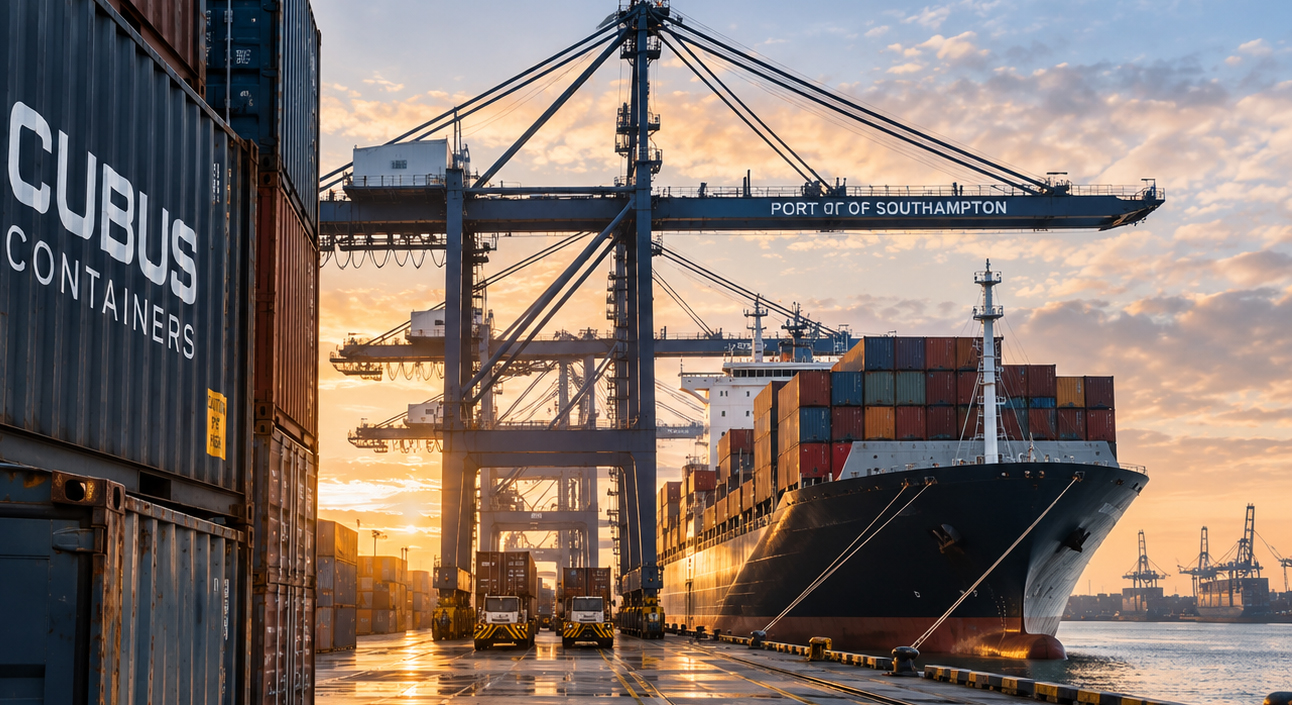
What would happen to UK trade if the country’s container ports simply stopped for a week?
The answer isn’t particularly comfortable.
Retail stock would start backing up. Manufacturers waiting for components would begin checking inventories rather nervously. Exporters would have containers sitting in yards instead of travelling towards customers. Warehouses, hauliers, rail freight operators and distribution centres would all feel the knock-on effect.
Because while Britain’s ports are often thought of simply as places where ships arrive and leave, modern container ports are considerably more important than that.
They are enormous logistics hubs connecting international shipping routes with Britain’s roads, railways, warehouses, factories, retailers and consumers.
And right now, UK container traffic is growing.
The latest Department for Transport figures show that container freight handled at UK major ports increased by 10% during 2025 to 66.9 million tonnes, while the number of container units increased by 11%.
Much of that growth came through London, where container traffic increased by 5.4 million tonnes, or approximately half a million container units. The opening of London Gateway’s £350 million fourth berth played a significant part in that expansion.
Meanwhile, Felixstowe continues to operate Britain’s largest intermodal rail freight facility, Southampton is investing £60 million in new quay cranes capable of servicing the world’s largest container ships, and Liverpool’s £400 million Liverpool2 development has created a major deep-water container gateway for businesses across the North and Midlands.
Container infrastructure isn’t some rusting monument to twentieth-century globalisation.
Britain is still investing heavily in it.
And there is a very good reason why.
UK Container Ports Are Part of Everyday Life
Container ports can feel rather distant from everyday business.
Unless you work in logistics, shipping or international trade, you probably don’t wake up wondering how many TEUs were unloaded overnight.
Fair enough.
But look around your office, warehouse, factory, shop or home and there is a very good chance that something you can see has travelled through a container port.
Computers.
Furniture.
Clothing.
Machinery.
Electrical equipment.
Tools.
Components.
Building products.
Packaging.
Food products.
Raw materials.
The modern UK economy relies on enormous international supply chains, and container ports are the physical gateways connecting those supply chains with businesses and consumers.
In 2025, all UK ports handled 428.3 million tonnes of freight. Major ports accounted for 419.5 million tonnes of that total.
Imports through major ports reached 237.5 million tonnes, while exports accounted for 98.6 million tonnes.
Containers represent only one category within that enormous freight system, alongside liquid bulk, dry bulk, Ro-Ro and other general cargo.
But container traffic is doing something particularly interesting.
It is growing.
Container Traffic Grew 10% in 2025
The Department for Transport’s latest annual statistics provide an interesting picture of changing UK freight patterns.
Overall port freight tonnage actually fell slightly during 2025.
Liquid bulk declined by 2%.
Ro-Ro declined by 2%.
Dry bulk declined by 3%.
Container freight went in completely the opposite direction.
Container tonnage increased 10% to 66.9 million tonnes.
That’s an additional 6.2 million tonnes of containerised freight moving through UK major ports in a single year.
The number of container units increased by approximately 600,000, an 11% rise.
Perhaps even more significantly, deep-sea container imports increased 12% to 25.1 million tonnes, the highest level recorded in the Department for Transport’s current statistical series. Imports from China accounted for the majority of that increase.
So if anyone tells you shipping containers are becoming less relevant, there are 66.9 million tonnes of evidence suggesting otherwise.
Britain’s Major Container Gateways
The UK doesn’t rely upon one enormous container port.
Instead, it has a network of ports positioned around the country, each offering different geographical and logistical advantages.
Among the most important are:
- Port of Felixstowe
- London Gateway
- Port of Southampton
- Port of Liverpool
Together with other ports and terminals, they connect British businesses with European, Asian, American and other global markets.
Their importance isn’t simply measured by the number of containers passing across a quay.
Location matters.
Rail connections matter.
Road access matters.
Warehousing matters.
Available land matters.
Ship size matters.
And increasingly, the ability to connect ports directly with inland logistics operations matters.
The modern container port is therefore becoming much more than somewhere to park a very large ship.
Port of Felixstowe: Britain’s Container Giant
For decades, Felixstowe has been synonymous with UK container shipping.
Located on the Suffolk coast, its position provides excellent access to major North European and international shipping routes.
Felixstowe says it handles trade with more than 200 countries and territories around the world.
But one of Felixstowe’s greatest strengths isn’t actually on the water.
It’s on the railway.
Felixstowe operates Britain’s largest intermodal rail facility and is the biggest generator of intermodal freight on the UK rail network. Around one million TEU of container traffic moves through its three rail terminals annually.
That is enormously important.
Containers arriving from international shipping routes don’t simply need to reach Britain.
They need to reach Birmingham, Manchester, Leeds, the Midlands and distribution centres across the country.
Rail allows huge quantities of containers to be moved inland efficiently.
Instead of hundreds of individual lorries travelling from the port, trains can carry large numbers of containers towards inland terminals where they can then be distributed closer to their final destinations.
Felixstowe describes itself as Britain’s biggest and busiest rail freight port, with dozens of daily trains connecting the port with inland destinations.
That’s a reminder of something easily overlooked.
The performance of a container port isn’t simply about how quickly containers come off a ship.
It’s also about how quickly they can leave the port.
Why Intermodal Freight Matters
Imagine a 20ft shipping container arriving in Britain from Asia.
It might contain manufacturing components destined for a factory in the Midlands.
The ship reaches Felixstowe.
A quay crane removes the container and places it into the terminal system.
From there, it could be transferred onto a freight train travelling inland.
At an inland terminal, the container is moved onto a road vehicle for the final stage of its journey.
The goods inside haven’t needed to be individually unloaded and repacked at every stage.
Ship.
Rail.
Road.
One container.
That is the beauty of intermodal transport.
And it is precisely why the standard shipping container became one of the most important inventions in global logistics.
London Gateway: The Rapidly Growing Challenger
If Felixstowe represents the established heavyweight of UK container shipping, London Gateway represents just how rapidly the country’s port infrastructure is evolving.
Located on the Thames Estuary, DP World’s London Gateway combines a deep-sea container port with a major logistics park.
Its location provides access to London and the South East — one of Europe’s largest consumer markets — while connecting directly with international shipping routes.
But the really interesting development has been its expansion.
In November 2024, London Gateway opened its £350 million fourth berth.
The new 430-metre berth increased the port’s trading capacity by more than a third.
And the effect showed up rather spectacularly in the 2025 statistics.
London Container Traffic Increased 38%
According to the Department for Transport, London handled 19.6 million tonnes of container traffic during 2025.
That represented an increase of 38% compared with 2024.
It also brought London’s container tonnage to a similar level to Felixstowe, which handled 19.3 million tonnes.
Across the year, London’s container traffic increased by approximately 5.4 million tonnes, or half a million container units.
The Department for Transport directly links much of this increase to additional capacity created by London Gateway’s fourth berth.
Think about that for a moment.
A major piece of infrastructure opens.
Additional vessels can be accommodated.
More containers can be handled.
And within the following year, millions of additional tonnes of containerised freight move through the region.
Infrastructure matters.
Quite a lot, apparently.
A Fourth Berth Built for the Future
The London Gateway development is particularly interesting because the fourth berth wasn’t simply about adding more concrete beside the Thames.
DP World designed it as an all-electric berth, using electric equipment including straddle carriers and automated stacking cranes.
The berth is capable of accommodating the enormous container vessels increasingly used on major international routes.
Modern container ships can carry well over 20,000 TEU.
When one of those vessels arrives, a port needs more than a big crane.
It needs enormous handling capacity.
Containers must be unloaded, moved through the terminal, stored temporarily, cleared and dispatched efficiently.
If any part of that system becomes a bottleneck, the problem quickly spreads backwards.
The world’s largest ships only make economic sense if ports can handle their cargo efficiently.
That is why investment in berth capacity, cranes, automation, rail infrastructure and inland logistics is becoming so important.
Southampton: Britain’s Southern Container Gateway
The Port of Southampton occupies another strategically important position in UK container trade.
Its south coast location provides relatively quick access to major international shipping routes while offering strong connections with inland markets.
Operated by DP World, Southampton is continuing to invest in container handling infrastructure.
A £60 million investment in four new quay cranes is designed to strengthen the terminal’s ability to handle the largest container vessels currently operating.
And these aren’t exactly cranes you’d quietly pop behind the warehouse.
DP World says the new equipment will stand taller than Big Ben, weigh more than 2,000 tonnes each and be capable of servicing vessels carrying around 24,000 TEU.
They are also designed to perform quad lifts, allowing two 40ft containers to be moved together between vessel and terminal.
The cranes are scheduled to arrive from mid-2026.
That’s a £60 million investment with an expected operational life of around 25 years.
Ports don’t spend that sort of money because they think container shipping is about to disappear.
Why Bigger Ships Change Everything
Container ships have become enormous.
And that creates a slightly strange situation.
Bigger vessels can create economies of scale at sea, but they also create enormous peaks in activity when they arrive in port.
Imagine thousands of containers needing to move on and off a vessel within a relatively short period.
The quay needs sufficient cranes.
The terminal needs sufficient storage.
The handling equipment needs sufficient capacity.
Customs and administration systems need to function.
Road connections need to cope.
Rail freight needs available slots.
Hauliers need to collect containers.
Warehouses need to receive them.
The port therefore becomes an enormous choreography of ships, cranes, computers, trains, lorries and steel boxes.
Get it right and the whole thing looks remarkably uneventful.
Get it wrong and suddenly the phrase “supply chain disruption” starts appearing in everyone’s inbox.
Liverpool: A Container Gateway for the North
On the opposite side of the country, Liverpool provides another strategically important route into the UK.
The Port of Liverpool has a long maritime history, but its modern container operation demonstrates how historic ports can reinvent themselves around contemporary trade.
The centrepiece is Liverpool2, a deep-water container terminal representing an investment of around £400 million.
The terminal was developed to enable very large container vessels to call directly at Liverpool.
Its location creates a particularly interesting proposition for businesses across northern England, the Midlands, Scotland and Ireland.
Peel Ports estimates that around 35 million consumers live within 150 miles of the Port of Liverpool.
That matters because the shortest sea journey isn’t necessarily the cheapest overall supply chain.
You have to consider what happens after the container lands.
Ports Need to Be Close to Their Customers
Suppose a container of goods is ultimately destined for a distribution centre in northern England.
Bringing that container into a southern port and transporting it hundreds of miles north may make sense depending on shipping schedules, costs and availability.
But if the same cargo can arrive through Liverpool, the inland road or rail journey could potentially be reduced.
That is part of Liverpool2’s strategic argument.
Peel Ports positions the development as a way of bringing deep-sea container shipping closer to major population and manufacturing centres in the North.
Shorter inland journeys can potentially mean:
lower haulage costs,
less congestion,
reduced road mileage,
and lower associated emissions.
There is no universally correct port for every shipment.
The best option depends on origin, destination, shipping line, route, availability, costs and onward logistics.
But having multiple capable container gateways gives UK businesses options.
And options make supply chains more resilient.
Ports Are Becoming Logistics Hubs
Perhaps the biggest change in modern container infrastructure is the blurring of the line between “port” and “logistics centre”.
Traditionally, you might imagine a port’s job ending once cargo left the gates.
Today, major operators increasingly think about the entire supply chain.
Ports connect with:
rail terminals,
road haulage,
warehouses,
distribution centres,
customs operations,
freight forwarding,
container depots,
and increasingly large logistics parks positioned directly alongside port infrastructure.
London Gateway is an obvious example of this integrated approach.
The port and logistics park sit together, allowing businesses to position warehousing and distribution operations close to where containers enter the country.
That can remove unnecessary stages from the supply chain.
Instead of:
ship → port → lorry → distant warehouse → lorry → distribution centre
the journey can potentially become considerably shorter.
Every unnecessary movement costs money.
UK Ports Connect Britain With Europe and the World
Container trade isn’t exclusively about enormous vessels arriving directly from China or other distant markets.
European trade and transhipment networks remain enormously important.
Department for Transport figures show that short-sea trade accounted for 65% of all UK international port tonnage during 2025, while deep-sea routes accounted for 35%.
The Netherlands alone accounted for 17% of UK international port tonnage, reflecting its role as a major European logistics and transhipment hub.
Interestingly, short-sea container traffic increased by 7% during 2025.
Container traffic between London and Dutch routes increased particularly strongly following the expansion of London Gateway.
So UK container ports aren’t simply gateways connecting Britain with distant continents.
They’re part of an interconnected European freight network as well.
Why Container Ports Matter to UK Businesses
For businesses importing or exporting goods, port performance can directly affect:
Delivery times
Delays at ports can quickly affect manufacturing schedules, retail availability and customer deliveries.
Transport costs
The location of a port relative to the final destination can make a substantial difference to inland haulage costs.
Inventory requirements
Reliable shipping allows businesses to operate with more predictable stock levels.
Unreliable shipping encourages companies to hold more inventory “just in case”.
And inventory costs money.
Export competitiveness
Efficient ports help British manufacturers and exporters get products to international markets more effectively.
Supply chain resilience
Access to multiple ports, shipping routes and inland transport options gives businesses alternatives when disruption occurs.
Ports are therefore not simply infrastructure for shipping companies.
They’re economic infrastructure for almost every business that relies upon internationally traded physical goods.
The Shipping Container Is the Common Link
Through all of this complexity sits one remarkably simple object.
The shipping container.
A 20ft container can arrive at Felixstowe and move inland by rail.
A 40ft container can arrive at London Gateway before travelling to a distribution centre.
A High Cube can enter through Southampton carrying imported products.
Another container can leave Liverpool carrying British exports.
Different ports.
Different ships.
Different cargo.
Different businesses.
The standardised container ties the whole system together.
It can move between ships, trains and road vehicles because the international logistics system has been built around common dimensions and handling standards.
That standardisation is what allows ports handling millions of tonnes of completely different products to operate efficiently.
What Happens to Containers After Shipping?
Not every shipping container spends its entire life travelling between international ports.
Eventually, containers are retired from active shipping fleets.
But that doesn’t mean the steel box has reached the end of its useful life.
Far from it.
Many used shipping containers go on to provide years of additional service as:
secure storage,
construction site stores,
agricultural storage,
workshops,
plant rooms,
site offices,
equipment stores,
and specialist converted spaces.
That’s where the container’s story becomes particularly relevant to Cubus Containers.
The international freight industry creates an ongoing supply of strong, modular steel structures.
Once those units leave active shipping service, they can become extremely practical assets for UK businesses.
A container that once passed through Felixstowe, Southampton, London or Liverpool might eventually spend the next decade storing equipment on a farm, construction site or commercial premises.
From Shanghai to Southampton to storing someone’s cement mixer.
Quite a career.
Case Study: London Gateway’s Fourth Berth
If you want one example demonstrating why container port investment still matters, London Gateway’s fourth berth is difficult to ignore.
DP World officially launched the new berth in November 2024 following an investment of approximately £350 million.
The 430-metre facility increased the port’s trading capacity by more than a third.
The investment included major new quay cranes and an electric fleet of terminal handling equipment.
Then came 2025.
Department for Transport figures show that London container traffic increased by 5.4 million tonnes, or approximately 500,000 container units, compared with 2024.
Total London container traffic reached 19.6 million tonnes, an increase of 38%.
That brought London broadly level with Felixstowe’s 19.3 million tonnes of container traffic for the year.
The growth continued to be visible towards the end of 2025.
In the fourth quarter alone, London’s container tonnage increased by 2.1 million tonnes compared with the same quarter of 2024 — a rise of 52%. Container units increased by 191,000, or 65%.
The Department for Transport repeatedly identifies the fourth berth as an important factor behind this increase.
That’s what port investment can do.
It isn’t infrastructure spending for infrastructure’s sake.
Additional berth capacity allows additional ships to call.
Additional cranes allow more containers to be handled.
More terminal capacity allows cargo to move more efficiently.
And better connections allow those containers to travel onwards into the domestic economy.
The London Gateway story demonstrates that container capacity can influence the geography of UK trade remarkably quickly.
Within a year of opening the additional berth, London’s container volumes had changed dramatically.
That’s not a theoretical future benefit.
It’s already happening.
Featured quote:
“Britain’s container ports aren’t simply places where ships stop. They’re the gateways connecting global trade with almost every part of the UK economy.”
Britain’s Container Ports Are Still Evolving
There is something reassuringly industrial about a container port.
Steel boxes.
Huge cranes.
Enormous ships.
Trains.
Lorries.
Not exactly Silicon Valley.
But underneath all that steel is an increasingly sophisticated logistics network involving automation, digital systems, electrification and enormous infrastructure investment.
Felixstowe continues to develop its rail capability.
London Gateway has expanded with a £350 million fourth berth.
Southampton is investing £60 million in cranes designed to service the latest generation of megaships.
Liverpool has invested £400 million in Liverpool2 to strengthen deep-water container access for the North.
Those aren’t the actions of an industry preparing for retirement.
They’re investments designed to keep Britain connected with global trade for decades to come.
The UK’s Container Ports Are More Important Than Ever
Shipping patterns will change.
Manufacturing locations will change.
Trade agreements will change.
Technology will certainly change.
But physical products still have to physically move.
You can’t download a sofa.
You can’t email an excavator.
And unfortunately, nobody has yet discovered how to send 20 tonnes of engineering components through WeTransfer.
For all the sophistication of the modern digital economy, international trade remains stubbornly physical.
And that means ports matter.
The UK’s container ports connect manufacturers, retailers, exporters and consumers with an international transport system capable of moving tens of millions of tonnes of goods every year.
The latest figures show that role is expanding rather than disappearing.
Container freight increased 10% during 2025.
Deep-sea container imports reached record levels within the current statistical series.
London’s container volumes increased dramatically following new investment.
And major ports across Britain continue to spend hundreds of millions of pounds expanding and modernising their infrastructure.
The steel shipping container might look remarkably ordinary.
The infrastructure required to keep millions of them moving is anything but.
Looking for a Shipping Container?
The journey doesn’t necessarily end when a container leaves Britain’s ports.
At Cubus Containers, we supply shipping containers for businesses across the UK, from straightforward secure storage to specialist container requirements and conversions.
Whether you’re looking for a 20ft shipping container, 40ft shipping container, new container, used container or converted container, we’ll help you identify the right option for your site and intended use.
Because while we rather enjoy talking about ports, cranes, ships and millions of tonnes of freight, what really matters is getting the right container to the right place.
Speak to Cubus Containers about your container requirements today.