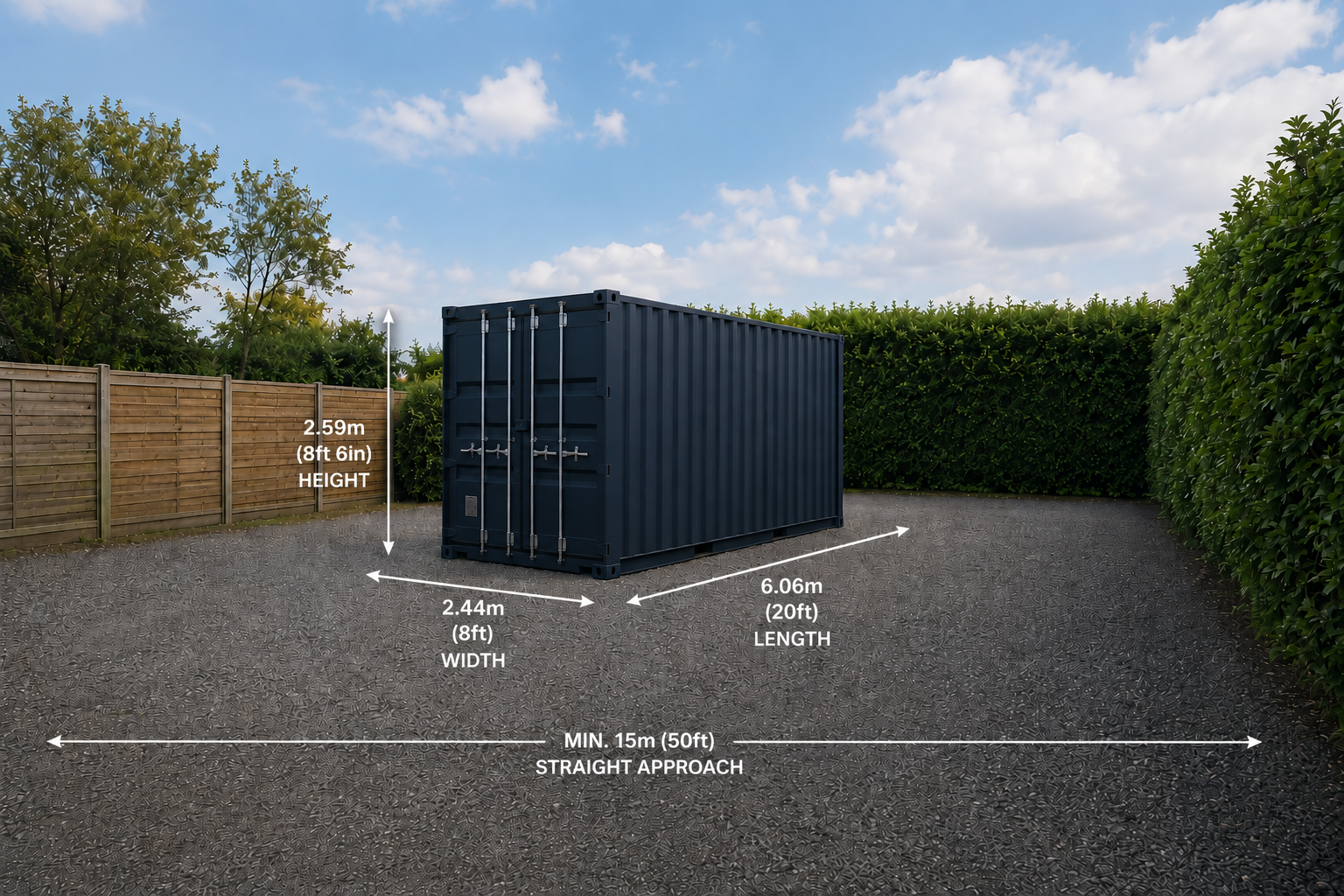
What makes a good container delivery site, and why does it always seem so obvious only after the lorry is halfway down the lane, the gate is an inch too narrow, and everyone is pretending the overhanging tree was never there?
A good container delivery site is not about having a dramatic clipboard, a hard hat that has never seen daylight, and a heroic amount of optimism. It is about access, space, ground conditions, safety and communication. In other words, the thrilling stuff that stops a simple delivery turning into a small village festival of reversing alarms, muttering, and someone called Dave saying, “It normally fits through there.”
Shipping containers are wonderfully practical once they are on site. They can provide storage, workshop space, plant rooms, site accommodation, pop-up retail space, agriculture support, equipment protection and all sorts of clever modular uses. But before any of that magic happens, the container needs to arrive, be positioned safely and sit properly once it is placed. That means the site must be ready before the vehicle turns up.
The best container delivery sites are not necessarily huge, shiny or industrial. They are prepared. They have clear access. They have a stable base. They have enough room for the delivery vehicle to manoeuvre. They are free from overhead obstructions. They keep pedestrians, staff, customers, animals, visitors and the resident office comedian away from the unloading area. They also have one decisive person on site who knows exactly where the container is going.
This guide explains what makes a good container delivery site in the UK, what to check before delivery day, what commonly causes delays, and how a little planning can save time, money and embarrassment. Because nobody wants their container delivery remembered as “that day we nearly redesigned the fence with a lorry”.
“A good container delivery site is not judged by how it looks on a sunny day. It is judged by whether a heavy vehicle can get in, place the container safely, and leave without drama.”
The simple truth: delivery success starts before delivery day
A shipping container delivery is not a magic trick. There is no stage curtain, no puff of smoke and sadly no glamorous assistant. There is a large vehicle, a heavy steel container, a planned delivery method and a site that either helps the process or makes everyone question their career choices.
Most delivery issues are not caused by the container. Containers are brilliantly predictable. A 20ft container is a known size. A 40ft container is a known size. A side-opening unit, tunnel container or modified container may need a little extra thought, but the principle is the same. The site is usually where the uncertainty lives. Access gates, soft ground, tight corners, parked cars, low branches, uneven concrete, hidden drains and overhead cables are the usual villains. None wear capes, but they do cause chaos.
A good container delivery site gives the delivery team three things: a safe route in, a safe place to unload, and a safe route out. That may sound painfully obvious, but so does “do not put diesel in a petrol car”, and yet here we are as a species.
The Health and Safety Executive’s workplace transport guidance points to the importance of planning vehicle movements, separating people from vehicles where possible, and keeping loading and unloading areas clear of passing traffic and people not involved in the work. This matters because container delivery involves heavy vehicles, heavy loads and moments where visibility and communication must be controlled, not guessed.
For businesses, farms, schools, construction sites, retail operators, local authorities and domestic customers, the goal is the same: make delivery boring. Boring is good. Boring means the lorry arrives, the driver knows where to go, the container is positioned, the doors open properly, paperwork is sorted and everyone gets on with their day. In logistics, boring is not dull. Boring is premium-grade professionalism wearing steel-toe boots.
Access: the first test your site has to pass
Access is the big one. If the delivery vehicle cannot reach the container position, the rest of the plan becomes a lovely piece of fiction. The delivery route must be wide enough, tall enough and strong enough for the vehicle and container combination. That includes roads, lanes, entrances, gates, yards, farm tracks, estate roads, business parks and temporary construction routes.
A common mistake is measuring the container position but forgetting the vehicle. A 20ft container may be compact in storage terms, but the vehicle delivering it still needs room. A 40ft container adds even more length, turning space and planning. Tight entrances, narrow lanes, awkward bends and parked cars can all make a site unsuitable without adjustment.
The access route should be checked from the main road all the way to the final placement area. Do not just stand by the gate and squint optimistically. Walk the route. Look at widths, corners, gradients, surface quality, overhead clearance and obstacles. Ask the deeply unromantic question: can a large vehicle actually do this without becoming a metal sculpture in the hedge?
For commercial sites, delivery access should be considered alongside normal operations. Is there staff parking in the way? Are forklifts moving nearby? Are customers using the same entrance? Is there a school run, shift change, bin collection or farm machinery movement happening at the same time? A good delivery site is not just physically accessible; it is operationally sensible.
For domestic and rural sites, the challenge is often the approach. Country lanes, tight gateways, soft verges, steep drives and low trees can catch people out. Rural sites are often perfect once the container is in place, but getting there can require more planning than expected. The countryside is beautiful. It is also very fond of narrow lanes designed during an era when traffic mostly had legs.
Ground conditions: containers like boring, stable surfaces
A good container delivery site needs suitable ground. That means firm, level and capable of supporting both the container and the delivery vehicle during placement. Hardcore, concrete and tarmac are usually far more delivery-friendly than soft grass, loose soil, saturated ground or decorative gravel that behaves like ball bearings with aspirations.
Ground conditions matter twice. First, the delivery vehicle needs a stable surface for manoeuvring and unloading. Second, the container needs a solid base so it sits level and drains properly. A container placed on poor ground may twist slightly, which can affect door operation. That moment when the doors suddenly refuse to close properly is not the container having a personality. It is physics, being smug.
The placement area should be level or prepared with appropriate supports. Many sites use concrete pads, railway sleepers, paving slabs, steel plates, compacted hardcore or purpose-made foundations. The exact solution depends on the container size, ground type, use case and how long the container will remain there. Temporary storage has different demands from a long-term workshop, insulated office or modified unit with services.
Drainage is often overlooked. If water pools around the base of the container, you may shorten its usable life and create unnecessary maintenance problems. Good sites encourage water to run away from the unit, not gather underneath it like a committee of damp regrets.
Soft ground is especially risky after heavy rain. A route that looked fine in July can become a pudding in November. If the vehicle is likely to cross grass, soil or unmade ground, the surface should be assessed honestly. Track mats or alternative routes may be needed. If in doubt, send photos and discuss the access before the delivery is booked. Guessing is not a plan; it is just gambling with a lorry.
Space around the delivery point: room is not a luxury
A container delivery site needs more than the exact footprint of the container. It needs working room. That includes space for the vehicle to arrive, turn, align, unload and leave. It also includes space around the container for doors, access, future use and maintenance.
One of the easiest mistakes is placing a container too close to a wall, fence, hedge, gate, building or another container. The unit may technically fit, but if the doors cannot open properly, congratulations, you have created a very secure box containing mostly disappointment.
Think about door swing. Standard container cargo doors need space in front of them. If you are placing a tunnel container, both ends may need access. If you are using a side-opening container, you need enough lateral clearance for the side doors and safe loading. If the container will be used for equipment storage, allow room for forklifts, pallet trucks, wheelbarrows, mower access, stock movement or whatever wonderfully British combination of tools and stubbornness your site requires.
A good container delivery site is planned for the container’s actual use, not just its arrival. Where will staff approach from? Will vehicles park near it? Will lighting be needed? Is there a safe pedestrian route? Are there security cameras? Will there be ramps? Does the container need ventilation, insulation, power or internal shelving? These choices affect positioning.
Space also matters for future removal or relocation. A container that is easy to place but impossible to collect later is not clever planning. It is a trap with branding. Always ask: could we remove this container again without demolishing half the site or phoning someone who owns a very expensive crane?
Overhead clearance: look up, because steel boxes do not duck
People are surprisingly good at checking ground-level obstructions and surprisingly bad at looking up. Yet overhead clearance is one of the most important parts of container delivery planning. Low branches, cables, building overhangs, signage, gantries, lighting columns, CCTV brackets and roof edges can all create problems.
Different delivery methods have different clearance needs. A delivery using lifting equipment may require additional height above the container. A vehicle may also need clearance along the access route, not just at the final position. If there are overhead power lines near the unloading area, the risk becomes serious and the delivery plan may need to change entirely.
A good delivery site has been checked vertically as well as horizontally. That means someone has walked the route and looked at every possible overhead obstruction. This is not glamorous work, but neither is explaining to a client that a tree branch is now part of the logistics department.
Branches can sometimes be trimmed before delivery, with permission where needed. Temporary signage, parked equipment and loose site materials can often be moved. Overhead cables are different. They need proper assessment, safe distances and professional judgement. Nobody should be improvising around live cables. That is not practical problem-solving; that is auditioning for an HSE case study.
For urban and commercial sites, also consider height restrictions at entrances and access roads. Car park barriers, archways and warehouse canopy edges can all be delivery blockers. For rural sites, tree canopies and uneven tracks are the usual suspects. Either way, look up early. It is cheaper than discovering gravity has a sense of humour.
Safety: keep people away from the delivery zone
A good container delivery site has a controlled delivery zone. This is not theatre. It is basic workplace transport safety. Heavy vehicles and heavy loads need clear space. Pedestrians, staff, customers, visitors and anyone not directly involved should be kept away from the unloading area.
The HSE highlights the importance of keeping loading and unloading areas clear of people not involved in the work, and using marked safe areas where drivers or observers need to stand. For container delivery, this means agreeing who is in charge on site, where people can stand, where they cannot stand, and how the driver will communicate with the site contact.
On busy business sites, the temptation is to keep normal operations running around the delivery. Sometimes that is possible, but it must be planned. Forklift routes, pedestrian walkways, vehicle entrances and customer areas need careful management. A container being placed is not background activity. It is the main character until it is safely down.
For schools, farms, retail sites and public-facing locations, safety planning becomes even more important. Curious people love watching a container being delivered. Unfortunately, curiosity has never been a recognised form of PPE. Use barriers, cones, signage, staff briefings or temporary route changes where appropriate.
A good site also has clear emergency thinking. What happens if access is blocked? Where can the vehicle wait safely? Who has authority to stop the delivery? Is there mobile signal? Is the site contact reachable? Most deliveries go smoothly. Good planning exists for the ones that do not.
Communication: the underrated hero of container delivery
Many delivery problems are not really access problems. They are communication problems wearing a hi-vis vest. The driver arrives and nobody knows where the container is going. The site manager is in a meeting. The person who booked the delivery is working from home. The gate code has changed. The dog is loose. A parked van is in exactly the wrong place. Logistics, as ever, becomes a sitcom.
A good delivery site has one named contact who is available on delivery day. That person should understand the plan, know the exact placement location, have authority to make decisions, and be able to keep people and vehicles out of the way. Ideally, they should not be discovering the plan via a forwarded email while standing in the rain.
Photos are extremely useful before delivery. Send images of the access route, gate, turning area, ground surface, final location and any potential obstacles. Include measurements where access is tight. A simple photo from the main entrance and another from the delivery point can prevent a lot of drama.
Clear instructions matter too. Use what3words, site maps, annotated images or simple written notes if the site is complex. Industrial estates, farms, schools, leisure sites and construction projects often have multiple entrances. The correct entrance is usually obvious to the person who goes there every day. It is not obvious to a driver seeing it for the first time while a queue forms behind them.
Good communication also means being honest about difficulties. Narrow entrance? Say so. Sloping yard? Say so. Low branch? Say so. Soft ground? Say so. Nobody wins when a site pretends to be easier than it is. Delivery teams can often work around constraints, but only when they know about them before the vehicle arrives.
A practical pre-delivery checklist
| Site factor | What to check |
|---|---|
| Access route | Check the full route from public road to final position. Look for narrow gates, tight turns, weak surfaces and parked vehicles. |
| Ground surface | Prepare firm, level ground such as concrete, tarmac, compacted hardcore or suitable supports. |
| Overhead clearance | Check for branches, cables, building overhangs, lights, signs and height barriers. |
| Working space | Allow room for the delivery vehicle to manoeuvre and for the container doors to open after placement. |
| Safety zone | Keep pedestrians, staff, customers and visitors away from the unloading area. |
| Site contact | Nominate one person who knows the placement plan and can make decisions on the day. |
| Drainage | Avoid low spots where water will pool under or around the container. |
| Future use | Position the container for access, security, loading, lighting, power and future collection. |
| Permissions | Check any lease, landlord, planning, highway, estate or local restrictions before delivery. |
| Photos | Send access and location photos before delivery where anything is uncertain. |
Common mistakes that make delivery harder than it needs to be
The first mistake is assuming that because the container fits, the vehicle fits. The second is assuming that because the vehicle can enter, it can unload. The third is assuming that because the ground is fine today, it will still be fine after two days of rain. Container delivery has a wicked little talent for exposing assumptions.
Another common mistake is placing the container where it looks neat rather than where it works. A container tucked tight against a boundary may please the eye, but if the doors are awkward, the access is poor or there is no safe loading area, the design has failed. Containers are practical assets. They need practical positioning.
Some sites forget about future access. A container installed during a quiet period may later be blocked by racking, fencing, landscaping, vehicles, temporary buildings or stock. Then, when the unit needs moving, everyone looks at the original decision with the kind of silence usually reserved for budget meetings.
Overconfidence is another expensive hobby. If an entrance is tight, measure it. If the ground is soft, prepare it. If overhead clearance looks close, check it. If there are buried services, drains or weak covers, identify them. If the site is busy, plan traffic movements. The phrase “we should be all right” has done more damage to delivery planning than most storms.
The good news is that almost all of these mistakes are preventable. A site survey, photos, honest conversation and a little preparation will usually solve the problem before it becomes a problem. Preparation is cheaper than delay, safer than improvisation and considerably less annoying than a failed delivery.
What different sites need to think about
Construction sites need to think about traffic management, ground conditions, changing access routes and interaction with plant machinery. What was accessible last week may now be blocked by materials, scaffolding or a trench with ambitions.
Farms and rural businesses need to think about lanes, gateways, soft ground, livestock areas, gradients and weather. A container can be brilliant for feed, tools, equipment, seasonal stock or workshop use, but the delivery route must match the reality of the site.
Schools, sports clubs and community sites need to think about people. Deliveries should be planned away from peak arrival and departure times where possible. Children, parents, members, visitors and spectators should be kept well clear of the delivery zone.
Retail and hospitality sites need to think about customers, parking, trading hours and visual impact. A container used for storage, pop-up trading, events or seasonal stock is useful only if its delivery does not cause unnecessary disruption.
Domestic customers need to think about access from the road, neighbour disruption, drive strength, underground services, boundary lines and whether the container can be collected again later. Also, telling the neighbour before the lorry arrives is often wise. It is not legally required in every case, but it does reduce curtain twitching by roughly 87 per cent.
Case study: the tidy business park delivery that nearly went sideways
A small manufacturing business on a business park needed a 20ft container for extra stock storage. On paper, the site looked easy. There was a wide estate road, a large yard, a clear loading bay and plenty of space behind the unit. The customer sent over the postcode, picked a delivery date and assumed the job would be straightforward. Which, in fairness, is exactly how most small disasters introduce themselves.
Two days before delivery, the site contact sent photos of the yard. The container position looked suitable, but the images revealed three issues. First, staff cars were normally parked along the access route. Second, the yard had a slight slope towards a drain cover near the proposed container position. Third, a row of low branches overhung the final approach from a neighbouring boundary.
None of these issues was dramatic on its own. Together, they could have caused a failed or delayed delivery. The parked cars would have restricted the vehicle’s turning angle. The drain cover raised a question about load-bearing strength. The branches were low enough to risk contact with the vehicle or container during positioning.
The solution was simple because the problems were found early. Staff were asked to park in the visitor bays for the morning. The container position was moved slightly away from the drain cover and onto a better-prepared area of compacted hardcore. The branches were trimmed with the neighbour’s permission. The site contact marked the placement area and briefed warehouse staff to keep forklifts away from the yard during the delivery slot.
On delivery day, the vehicle arrived, entered through the correct gate, turned safely, placed the container in the marked position and left without delay. The container doors opened cleanly, the unit sat level, and the customer could start using it the same day. Nothing dramatic happened. No heroic rescue. No frantic phone calls. No one had to pretend a forklift was “just about to move anyway”.
That is the point. A good delivery site does not need to be perfect. It needs to be understood. Small issues spotted early are usually easy to manage. Small issues discovered when the vehicle is already on site are suddenly everyone’s problem. Planning turned this delivery from a potential faff-festival into exactly what container delivery should be: safe, efficient and gloriously uneventful.
Final thoughts: good sites make good deliveries
A good container delivery site is not created by luck. It is created by checking access, preparing the ground, allowing enough space, managing safety and communicating clearly. None of this is glamorous. All of it matters.
The container itself is only part of the story. The site decides how smoothly delivery happens, how safely the unit is positioned and how well it performs once it is there. A container placed on a level, accessible, well-drained base will be easier to use, easier to maintain and easier to move in the future.
So before the delivery vehicle arrives, walk the route. Look up. Look down. Measure the awkward bits. Move the parked cars. Check the ground. Clear the delivery zone. Appoint a site contact. Send photos. Ask questions early. Basically, do all the sensible things that feel boring until the day they save you several hundred pounds, three hours and a deeply sarcastic conversation in the yard.
A good container delivery site is simple, safe and ready. And in the world of heavy steel boxes, that is about as close to poetry as we need to get.
Planning a container delivery?
Speak to Cubus Containers before delivery day. Tell us about your site, send a few photos, and we will help you choose the right container and prepare the delivery area properly — because “we’ll wing it” is not a logistics strategy.