What happens when you need secure storage, but your site is so awkward even a standard container delivery lorry refuses to entertain the idea?
There is a quiet revolution happening across UK construction sites, farms, schools, event spaces, and city-centre developments. While most people still picture shipping containers arriving on massive HIABs or sidelifters with enough room to land a helicopter, flat pack containers are solving one of the biggest logistical headaches in the industry: terrible access.
And by terrible, we mean genuinely awful.
Narrow country lanes. Underground car parks. Tight commercial estates. Rear access through alleyways. Construction sites with height restrictions. Buildings with no crane access. Sites where a 40ft articulated vehicle would need the turning circle of a cruise ship.
Traditionally, these sites either paid significantly more for bespoke logistics or simply gave up on container storage entirely. Flat pack containers change that equation completely.
They arrive in pieces, fit through restricted spaces, and can often be assembled directly on-site in areas impossible to reach with conventional container delivery methods. In many cases, they are the difference between having secure on-site storage and having none at all.
As UK sites become tighter, urban developments become denser, and temporary storage becomes increasingly important, flat pack containers are moving from niche product to essential solution.
And frankly, they are one of the smartest storage products most businesses still know very little about.
Why Access Problems Are Becoming More Common
The UK was not designed for modern logistics.
That sounds obvious, but it matters.
Many industrial estates were built decades ago. Residential developments squeeze every inch of land possible. Urban regeneration projects often operate within confined footprints. Rural sites come with narrow roads, trees, weak ground conditions, and impossible turning circles.
Standard shipping containers require:
- Large delivery vehicles
- Clear overhead access
- Sufficient turning space
- Stable unloading zones
- Room for cranes or sidelifters to operate
That is before we even discuss health and safety considerations.
Now imagine trying to deliver a container into:
- A basement car park
- A school courtyard
- A city-centre construction project
- A rear garden commercial build
- A rooftop development site
- A railway-side compound
- A restricted-access utility project
Suddenly, a “simple container delivery” becomes a logistical soap opera.
Flat pack containers exist specifically to solve this problem.
What Is a Flat Pack Container?
A flat pack container is exactly what it sounds like.
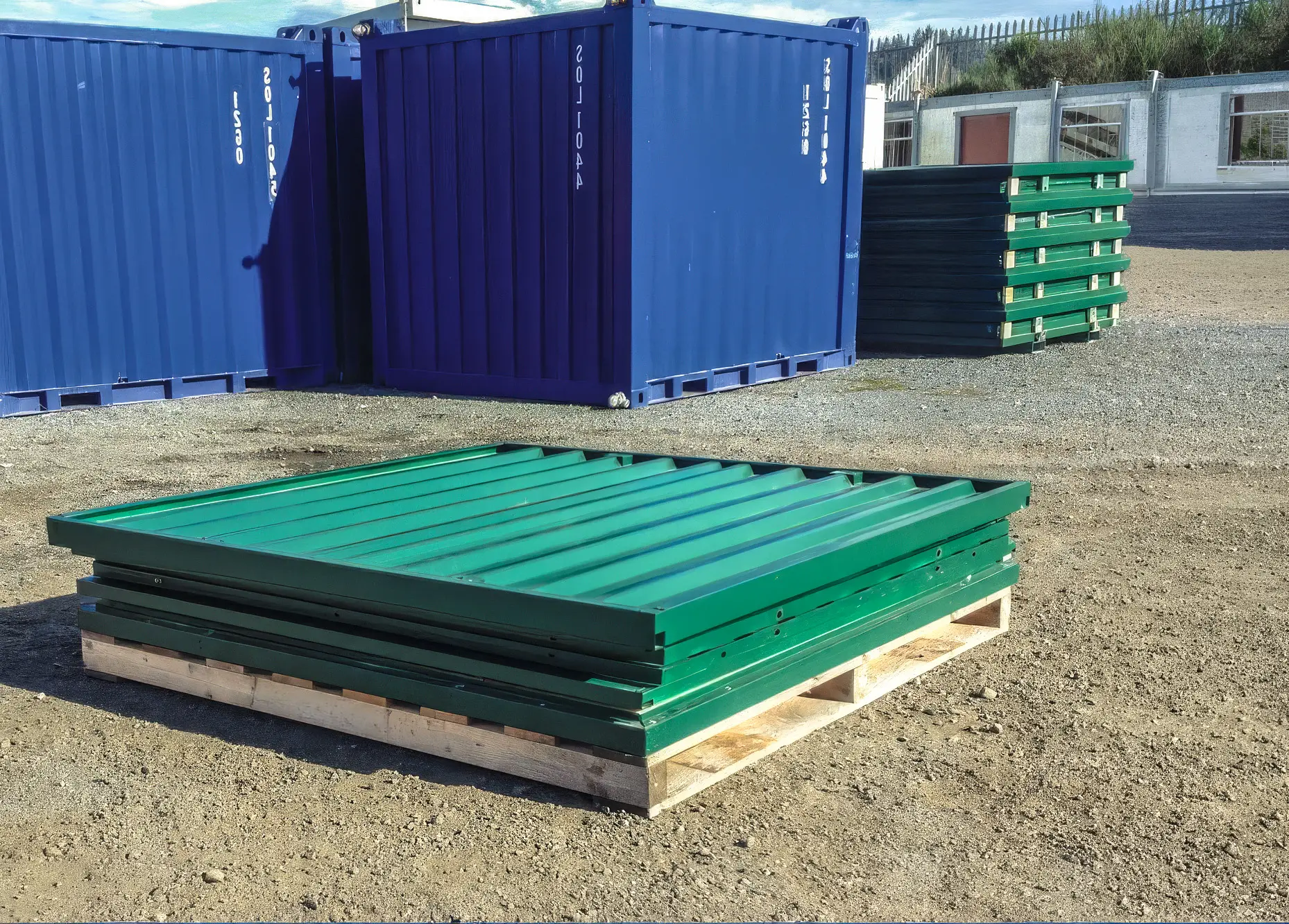
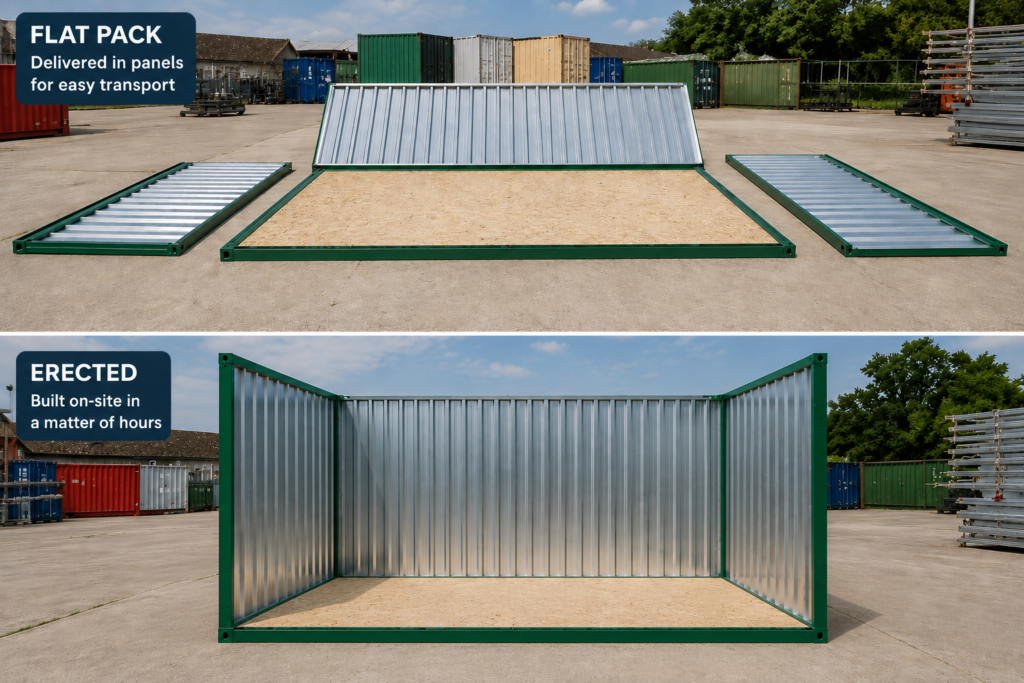
Instead of arriving as a fully assembled steel shipping container, the unit arrives in modular sections that can be manually moved and assembled on-site.
Typically, the components include:
- Steel floor base
- Wall panels
- Roof section
- Doors
- Locking hardware
The sections are compact enough to fit through narrow spaces, gates, corridors, restricted access routes, and awkward delivery points.
Once assembled, the finished structure functions similarly to a traditional storage container.
The difference is how it gets there.
Think IKEA. But for industrial storage. And thankfully with fewer emotional breakdowns and leftover screws.
Why Businesses Are Switching to Flat Pack Containers
The demand for flat pack storage is increasing because modern sites are becoming harder to access.
Businesses are discovering that traditional containers are often overkill for certain environments.
Flat pack containers offer several advantages:
Easier Delivery
This is the headline benefit.
The container components can often be delivered using smaller vehicles that can access areas impossible for standard container transport.
That means:
- Reduced delivery complications
- Lower crane requirements
- Fewer road access problems
- Easier urban deployment
- Less disruption on-site
For many projects, this is the deciding factor.
Faster Site Deployment
Flat pack containers can usually be assembled quickly once delivered.
Many systems are designed for rapid installation using basic tools.
This makes them ideal for:
- Temporary construction projects
- Event sites
- Emergency storage
- Schools
- Utility works
- Pop-up operations
Instead of waiting for specialist lifting equipment or complex logistics planning, businesses can often get operational far faster.
Reduced Transport Costs
Transporting fully assembled containers is expensive.
You are effectively paying to move a large steel box filled mostly with air.
Flat pack containers use transport space far more efficiently.
Multiple units can often be delivered together in a single load, reducing overall logistics costs.
This becomes particularly valuable for large multi-container projects.
Ideal for Temporary Sites
Not every site needs permanent infrastructure.
Flat pack containers are perfect for temporary operations because they can be:
- Disassembled
- Relocated
- Reused
- Reconfigured
This flexibility makes them popular for contractors working across multiple locations.
Common Uses for Flat Pack Containers
The versatility of flat pack storage is one reason demand continues to grow.
Construction Sites
Construction projects often face terrible access conditions.
Especially in towns and cities.
Flat pack containers provide secure tool and equipment storage without requiring major lifting operations.
They are frequently used for:
- Welfare storage
- Tool storage
- Material storage
- Temporary site offices
Schools and Universities
Educational sites often have restricted delivery windows and limited access.
Flat pack containers are ideal for:
- Sports equipment storage
- Temporary classrooms
- Maintenance storage
- Archive storage
Many schools simply do not have the space for traditional container deliveries.
Events and Festivals
Temporary event infrastructure needs flexibility.
Flat pack containers work well for:
- Ticket offices
- Vendor storage
- Equipment compounds
- Backstage operations
And when the event ends, the containers can move on.
Urban Developments
City-centre projects are where flat pack containers really shine.
Tight access, parking restrictions, pedestrian zones, and limited unloading areas make traditional containers difficult.
Flat pack systems remove many of those logistical barriers.
Farms and Rural Sites
Ironically, rural access can be just as difficult as urban access.
Narrow lanes, bridges, soft ground, and remote locations create delivery problems for large vehicles.
Flat pack containers offer a practical alternative.
The Big Question: Are Flat Pack Containers Secure?
This is usually the first concern.
People hear “flat pack” and imagine flimsy garden sheds held together by optimism and self-tapping screws.
Modern flat pack containers are considerably more robust than that.
Good quality units feature:
- Galvanised steel construction
- Reinforced doors
- Heavy-duty locking systems
- Weather-resistant seals
- Steel flooring systems
While they may not match the structural integrity of ISO shipping containers designed for global freight transport, they provide excellent security for most storage applications.
For tools, equipment, materials, archives, stock, and general site storage, they are often more than sufficient.
Weather Resistance and Durability
The UK climate enjoys attacking anything left outdoors.
Rain. Wind. Frost. Condensation. Sideways rain pretending to be weather.
Flat pack containers are specifically designed for external use and generally offer strong weather protection when correctly assembled.
Quality matters enormously here.
Cheaper units can suffer from:
- Water ingress
- Poor seals
- Corrosion
- Weak roof structures
Better units include:
- Galvanised finishes
- Proper drainage design
- Anti-condensation roofing
- Durable locking systems
A properly installed flat pack container should comfortably withstand typical UK conditions.
Flat Pack vs Traditional Shipping Containers
Both have strengths.
The right choice depends entirely on site conditions and intended use.
Traditional Shipping Containers Win On:
- Structural strength
- Long-term durability
- Heavy-duty industrial use
- Stacking capability
- Freight compatibility
Flat Pack Containers Win On:
- Access flexibility
- Easier installation
- Transport efficiency
- Temporary deployment
- Urban site suitability
In reality, the decision often comes down to one brutal truth:
Can a normal container physically reach your site?
If the answer is no, flat pack becomes extremely attractive.
The Hidden Cost of Bad Access
This is where businesses get caught out.
A cheap container can become very expensive if delivery access is poor.
Additional costs can include:
- Road closures
- Specialist cranes
- Traffic management
- Escort vehicles
- Failed delivery charges
- Site preparation works
Sometimes the delivery costs exceed the container itself.
Flat pack containers help eliminate many of these hidden expenses.
That is why they are increasingly being chosen even when standard containers technically could fit.
The logistics become simpler.
And simpler usually means cheaper.
Flat Pack Containers and Sustainability
Sustainability is becoming increasingly important in construction and logistics.
Flat pack containers offer several environmental advantages:
- Reduced transport emissions
- More efficient load capacity
- Reusable structures
- Lower site disruption
- Reduced heavy lifting equipment usage
Because multiple units can be transported together efficiently, the overall carbon footprint per unit can often be reduced compared to traditional container delivery.
It is not just about storage anymore.
Businesses increasingly want operational efficiency alongside environmental responsibility.
What to Consider Before Buying a Flat Pack Container
Not all flat pack containers are equal.
Before purchasing, businesses should consider:
Access Conditions
Measure everything carefully.
Including:
- Gate widths
- Height restrictions
- Turning circles
- Ground conditions
- Internal access routes
The irony of ordering a flat pack container that still cannot fit through the final doorway is not lost on anyone.
Intended Use
Will it store:
- Tools?
- Stock?
- Equipment?
- Documents?
- Chemicals?
- Machinery?
Different uses may require different specifications.
Security Requirements
Higher-value storage may require:
- Enhanced locks
- Lock boxes
- Alarm systems
- CCTV integration
Ventilation
Condensation is a real issue in UK storage environments.
Proper ventilation matters.
Especially for equipment, paperwork, or stock-sensitive materials.
Future Relocation
One of the biggest advantages of flat pack systems is mobility.
If the container may need relocating later, choose a system designed for repeated assembly and disassembly.
Why Flat Pack Containers Are Growing in Popularity Across the UK
The market conditions are almost perfectly aligned for growth.
The UK is seeing:
- More urban construction
- More constrained developments
- Higher storage demand
- Rising logistics costs
- Greater temporary infrastructure requirements
At the same time, businesses are becoming more practical.
They want solutions that work.
Not solutions that require a six-week logistics operation and three traffic marshals holding clipboards.
Flat pack containers solve genuine operational problems.
That is why demand is rising.
Case Study: Solving a City Centre Access Nightmare
A commercial refurbishment project in a busy town centre required secure on-site storage for contractors, tools, and materials.
The problem?
The site sat behind a pedestrianised retail zone with:
- Restricted delivery hours
- Narrow service access
- Low overhead clearance
- No crane access
- Tight turning space
A traditional shipping container delivery was ruled out almost immediately.
Initial quotes for alternative lifting solutions involved:
- Night-time road closures
- Mobile crane hire
- Temporary parking suspensions
- Traffic management permits
The logistics costs alone became commercially unrealistic.
The contractor instead opted for multiple flat pack storage containers.
The units arrived on smaller vehicles during permitted access hours. Individual sections were manually moved through the service corridor and assembled directly inside the compound.
Within a single day, the site had secure storage operational without requiring cranes, specialist lifting equipment, or disruptive road closures.
The project manager later estimated the decision saved several thousand pounds in logistics costs alone.
More importantly, the project avoided delays.
And in construction, delays are where budgets go to die.
“The best storage solution is not always the biggest container. Sometimes it is the one that can actually reach your site.”
Final Thoughts
Flat pack containers are not replacing traditional shipping containers.
They are solving a different problem entirely.
For sites with excellent access, large-scale industrial requirements, or long-term heavy-duty use, standard containers remain incredibly effective.
But for awkward sites, urban projects, temporary operations, and restricted-access locations, flat pack containers offer something many businesses desperately need:
Practicality.
Because storage is useless if you cannot get it onto the site in the first place.
And increasingly across the UK, access is becoming the real challenge.
FAQs
Are flat pack containers waterproof?
Good quality flat pack containers are designed to be weather resistant and suitable for UK outdoor use. Quality and installation both matter significantly.
How long does it take to assemble a flat pack container?
Many units can be assembled within a few hours depending on size, ground conditions, and experience.
Can flat pack containers be moved after installation?
Yes. One of their biggest advantages is the ability to disassemble and relocate them to new sites.
Are flat pack containers secure enough for tools?
Most quality flat pack containers are suitable for tool and equipment storage, especially when fitted with upgraded locking systems.
Do flat pack containers need foundations?
Usually they require level, stable ground. Concrete pads, compacted hardcore, or similar stable surfaces are commonly used.