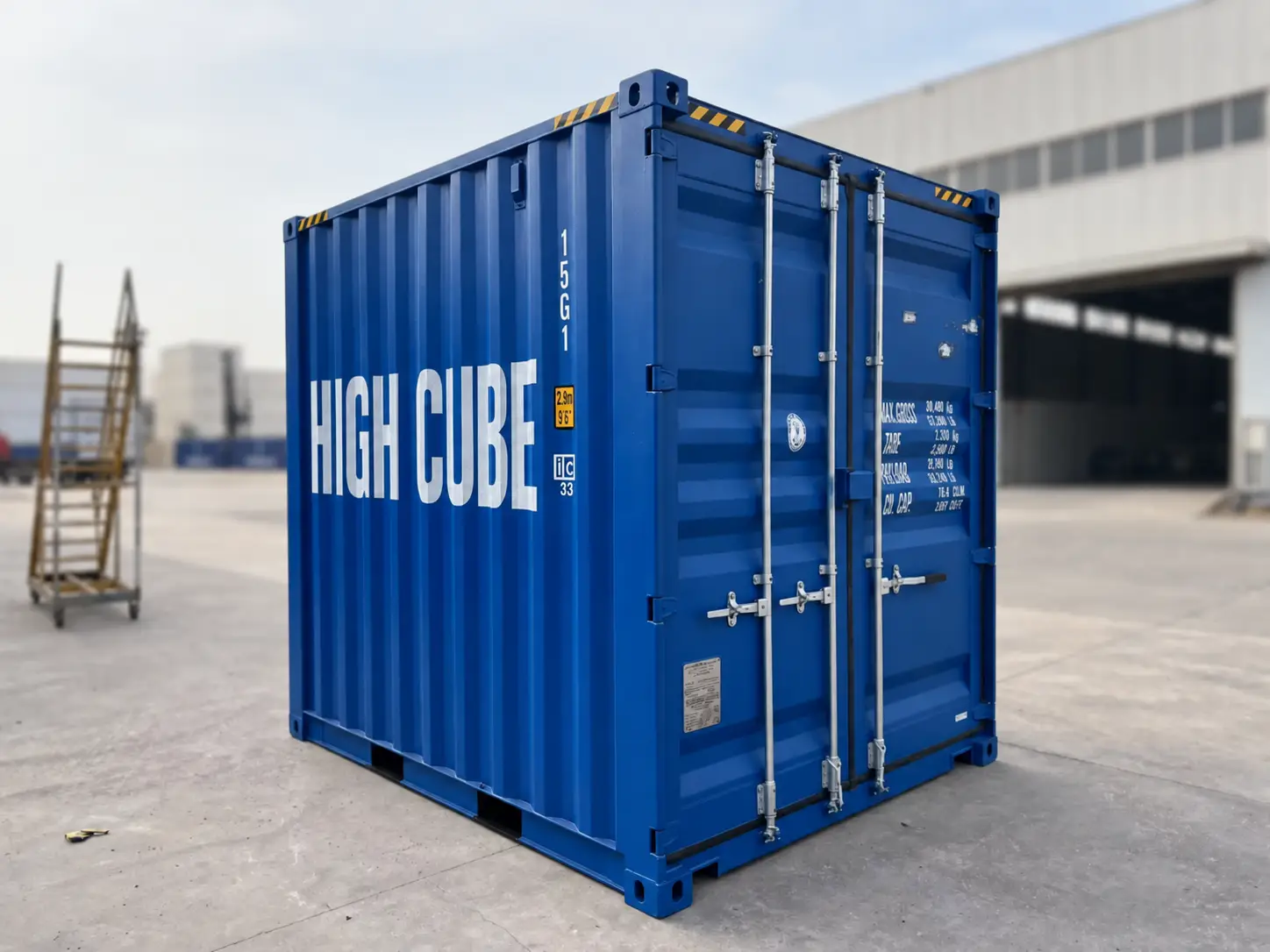
If you are already buying or hiring a shipping container, does an extra foot of height really make that much difference?
Very often, yes.
At first glance, a High-Cube shipping container doesn’t look dramatically different from a standard shipping container. It is still a large steel box, still available in familiar container lengths, and still designed around the same basic principles that have made shipping containers so useful around the world.
But there is one important difference.
Height.
A standard shipping container is typically 8ft 6in high, while a High-Cube container is 9ft 6in high. That extra 12 inches might not sound particularly exciting, but across a 40ft container it creates a substantial amount of additional usable internal volume. MSC lists a typical 40ft High-Cube dry container with an internal height of around 2.7 metres, while international container guidance defines High-Cube units around the 9ft 6in external height.
For businesses using containers for storage, workshops, equipment, conversions or bulky cargo, that additional headroom can completely change how useful the space becomes.
And unlike simply choosing a longer container, a High Cube gives you that additional capacity without increasing the footprint of the container on your site.
Same length.
Same basic width.
More space.
Which is a rather useful trick when land isn’t getting any cheaper.
What Is a High-Cube Shipping Container?
A High-Cube shipping container is essentially a taller version of a standard ISO-style shipping container.
The most familiar version is the 40ft High Cube, although High-Cube configurations are available in other lengths depending on specification and availability.
A typical standard 40ft container has external dimensions of approximately:
40ft long × 8ft wide × 8ft 6in high
A typical 40ft High-Cube container is approximately:
40ft long × 8ft wide × 9ft 6in high
So the important number is that extra one foot — approximately 305mm — of external height.
Maersk’s equipment specifications illustrate the difference clearly. Its standard 40ft dry container is listed at 8ft 6in high with around 2,366 cubic feet of capacity, while the 40ft High-Cube version is 9ft 6in high with around 2,684 cubic feet of capacity.
That’s hundreds of additional cubic feet without making the container any longer.
For bulky but comparatively lightweight goods, that’s extremely valuable.
Standard Container vs High Cube
The easiest way to understand the benefit is to compare the two.
Standard 40ft shipping container
A standard 40ft container typically provides roughly:
- 40ft external length
- 8ft external width
- 8ft 6in external height
- Around 2.39m internal height, depending on manufacturer
- Around 67 cubic metres of internal capacity
40ft High-Cube shipping container
A typical 40ft High Cube provides approximately:
- 40ft external length
- 8ft external width
- 9ft 6in external height
- Around 2.69–2.70m internal height
- Around 76 cubic metres of internal capacity
MSC, for example, lists its 40ft High-Cube steel container with internal dimensions of approximately 12.03m long, 2.35m wide and 2.7m high.
The precise dimensions vary slightly between manufacturers and individual containers, so you should always check the specification of the actual unit you’re considering.
But the principle remains the same.
A High Cube gives you substantially more vertical space.
How Much More Space Do You Actually Get?
This is where the High Cube starts making considerably more sense.
If the length and width remain approximately the same, adding an extra foot of height across a 40ft container produces around 9 cubic metres of extra internal capacity, depending on specification.
That’s roughly a 13% increase in volume compared with a standard 40ft dry container.
And you haven’t taken up another inch of ground space.
For a business paying for every square metre of yard, warehouse or development space, that matters.
Think vertically rather than horizontally.
A High Cube can allow you to store:
another level of boxes,
taller palletised goods,
higher shelving,
larger machinery,
longer upright equipment,
or bulky products that would otherwise waste space.
It isn’t simply “a bit taller”.
It can change how efficiently the entire container is used.
Featured quote:
“A High-Cube container gives you more usable space without asking for more land — and that extra foot can make a surprisingly big difference.”
Benefit 1: More Storage Without a Bigger Footprint
Probably the clearest advantage of a High-Cube shipping container is increased storage capacity.
Suppose your site can comfortably accommodate a 40ft container.
Putting a second container beside it might not be possible.
There may be:
access routes,
parking,
buildings,
boundaries,
delivery areas,
other storage,
or planning considerations
to work around.
A High Cube allows you to increase internal capacity vertically instead.
The footprint remains essentially the same as a standard 40ft shipping container, but the usable volume increases.
For many commercial sites, that’s far more practical than adding another storage unit.
Businesses increasingly need to squeeze more productivity from the space they already occupy.
A High Cube does precisely that.
Benefit 2: Better for Bulky Goods
Weight isn’t always the limiting factor when you’re storing goods.
Sometimes the problem is simply volume.
Think about:
furniture,
packaging,
insulation materials,
display equipment,
plastic products,
textiles,
event equipment,
large components,
empty containers,
lightweight building products,
and manufactured goods with lots of air around them.
These products can fill a standard container long before they approach its maximum weight capacity.
This type of cargo is sometimes described as being volume constrained rather than weight constrained.
In that situation, High-Cube containers make enormous sense.
Maersk specifically describes the 40ft High Cube as suited to lighter cargo where additional volume is useful.
If you’re running out of space before you’re running out of allowable weight, buying more cubic capacity is the obvious answer.
Benefit 3: Improved Shelving Options
Storage containers become considerably more efficient once proper shelving is installed.
Without shelving, businesses have a habit of creating what can only politely be described as “the pile”.
Boxes go in.
Equipment gets put in front of the boxes.
Someone places something “temporarily” in the doorway.
Six months later nobody can reach anything beyond the first three metres.
Excellent.
High-Cube containers give you more vertical room for shelving systems.
That additional height may allow:
more shelf levels,
greater spacing between shelves,
storage of tall items beneath shelving,
or better overhead storage.
For businesses storing stock, parts, consumables or tools, this can dramatically improve organisation.
And better organisation means less time spent hunting for something that everybody insists was definitely put in the container last Tuesday.
Benefit 4: Better Headroom
High Cubes aren’t only useful because you can stack things higher.
They’re also more comfortable spaces to physically work inside.
The extra internal height gives noticeably greater headroom.
That can be particularly useful if the container is being used as:
a workshop,
equipment room,
plant room,
maintenance space,
site office,
studio,
or converted commercial unit.
Once you start adding internal floors, ceiling finishes, insulation, cabling and lighting, the advantages become even more obvious.
A standard container is perfectly usable for many purposes.
But every layer added inside reduces available headroom.
Starting with an additional foot gives designers and converters considerably more room to play with.
Benefit 5: High Cubes Are Excellent for Container Conversions
This is arguably where High-Cube shipping containers really come into their own.
A shipping container intended purely for storage needs relatively little modification.
A converted container is different.
Imagine you’re creating a:
site office,
workshop,
studio,
welfare unit,
retail space,
temporary classroom,
equipment control room,
or hospitality unit.
You may want to add:
floor insulation,
ceiling insulation,
wall linings,
electrical conduits,
air conditioning,
ventilation,
lighting,
suspended ceilings,
floor finishes,
and structural reinforcements.
All these things consume space.
In a standard-height container, losing even 100–150mm at floor and ceiling level can noticeably change how the interior feels.
With a High Cube, you begin with substantially more height.
After conversion work is complete, the finished space can therefore feel much less restrictive.
Benefit 6: More Room for Insulation
Insulation deserves its own mention because it is central to many container conversions.
Steel containers react quickly to outside temperatures.
In direct sunshine, an uninsulated steel container can become very warm.
During colder conditions, the steel shell can become cold, creating potential condensation issues if moisture inside isn’t properly managed.
Depending on the intended use, a conversion may therefore include insulation within the walls and ceiling.
But insulation has thickness.
Add insulation.
Add framing.
Add lining.
Add ceiling services.
Suddenly you’ve removed a noticeable amount of internal space.
The extra height of a High Cube helps compensate for that.
For a simple storage container, this may not matter.
For an office, workshop or occupied conversion, it absolutely can.
Benefit 7: Better for Tall Equipment
Sometimes the reason for choosing a High Cube is wonderfully straightforward.
The thing you need to put inside is too tall.
Industrial and commercial businesses use containers to store and protect all sorts of equipment:
machinery,
fabrication equipment,
racking,
electrical cabinets,
pumps,
compressors,
agricultural equipment,
workshop systems,
engineering equipment,
and specialist plant.
A standard container may physically accommodate most of the equipment, but the additional High-Cube clearance can make loading, positioning and servicing considerably easier.
However, always check both the internal height and door opening height.
This is important.
Having enough room once the equipment is inside doesn’t help much if you can’t actually get it through the doors.
Shipping container specifications can vary, so dimensions should be confirmed before purchasing a container for specific machinery.
Benefit 8: Increased Door Height
High-Cube containers typically offer taller door openings than their standard-height equivalents.
That can be extremely useful when loading bulky items.
MSC’s typical 40ft High-Cube specification, for example, lists a door height of around 2.58 metres, although exact dimensions vary.
That additional opening height can be important for:
palletised products,
machinery,
large packaging,
industrial equipment,
furniture,
and other awkward loads.
Again, this is where measuring properly matters.
Never assume that because the container is 9ft 6in externally, you have 9ft 6in available through the doors.
You don’t.
Structural rails, flooring and the container frame reduce the usable opening.
Measure twice.
Order once.
It tends to be cheaper than discovering your expensive machine is 40mm too tall while a delivery driver watches.
Benefit 9: High Cubes Work Well with Racking
Warehouses don’t waste vertical space.
And neither should container storage.
If you’re installing racking inside a shipping container, a High Cube potentially allows greater vertical utilisation.
A carefully designed racking system can transform a container from a big steel cupboard into a genuinely efficient storage facility.
You might use:
adjustable shelving,
industrial racking,
parts bins,
tool racks,
hanging storage,
or bespoke fabricated systems.
The extra height gives more options.
For businesses storing large numbers of smaller products, the difference can be particularly valuable because adding another shelving level across the full length of a 40ft container creates a surprising amount of extra storage.
Benefit 10: Better for Archive Storage
Businesses, organisations and schools sometimes use shipping containers for archive storage.
While we’re all supposedly heading towards a glorious paperless future, somebody forgot to tell the filing cabinets.
Boxes of records can consume huge amounts of space.
For long-term archive storage, vertical stacking or shelving becomes important.
A High Cube gives businesses more internal capacity within essentially the same site footprint.
However, archive storage should always be approached carefully.
Paper is sensitive to moisture and condensation.
If documents are valuable or need to be retained for regulatory reasons, appropriate ventilation, insulation, moisture management and storage systems should be considered.
A shipping container can provide excellent secure storage.
But putting cardboard boxes directly against cold steel walls and hoping for the best isn’t a storage strategy.
Benefit 11: Useful for Construction Sites
Shipping containers and construction sites are practically old friends.
Containers are commonly used for:
tool storage,
materials,
site equipment,
PPE,
workshops,
temporary offices,
and welfare facilities.
A High Cube offers all the usual security and portability advantages while giving site teams additional volume.
Construction sites are also constantly changing.
A container can be delivered when required and potentially moved when the project progresses.
Compared with creating permanent storage, that flexibility can be extremely useful.
High Cubes are particularly attractive where valuable equipment needs to be stored efficiently without consuming excessive site space.
Benefit 12: Agricultural Storage
Farms have a remarkable ability to accumulate equipment.
Tools.
Feed equipment.
Fencing.
Machinery parts.
Packaging.
Seasonal items.
Animal-care equipment.
And at least seventeen things nobody remembers buying.
High-Cube containers can provide useful additional agricultural storage without requiring a traditional permanent building.
The extra vertical space is particularly useful for bulky agricultural equipment or shelving.
As with any storage application, however, the container specification needs to match what you’re putting inside.
Ventilation may be important.
Humidity may need managing.
Some products require specialist storage conditions.
And chemicals, fuels or hazardous materials may be subject to separate legal and safety requirements.
“Put it in a container” is useful advice.
It isn’t universally applicable advice.
Benefit 13: Event and Exhibition Equipment
Event companies face a particularly awkward storage problem.
Much of their equipment is relatively lightweight but incredibly bulky.
Think:
staging components,
display equipment,
signage,
furniture,
gazebos,
lighting equipment,
barriers,
decorations,
cases,
and exhibition materials.
This is precisely the kind of application where High-Cube capacity becomes useful.
The goods may not weigh very much, but they consume enormous volumes of space.
A High Cube lets businesses maximise storage within the same footprint.
The container itself can also potentially be moved between storage locations or event sites, depending on operational requirements.
Benefit 14: Retail Overflow Storage
Retail has peaks.
Christmas.
Summer.
Black Friday.
New product launches.
Promotions.
Seasonal ranges.
Then suddenly somebody has ordered approximately three times as many inflatable flamingos as can fit in the stockroom.
A shipping container can provide useful overflow storage.
A High Cube provides even more.
For bulky retail products or packaged goods, the extra capacity can help businesses handle short-term or seasonal stock increases without immediately expanding warehouse premises.
And when warehouse and commercial space is expensive, squeezing additional cubic capacity from an existing yard can be financially attractive.
Benefit 15: More Future-Proof
One slightly less obvious advantage of choosing a High Cube is flexibility.
Your current requirement might simply be storage.
But what about three years from now?
Perhaps the container will eventually become:
a workshop,
a fitted-out equipment room,
an office,
a specialist conversion,
or a more sophisticated storage facility with racking.
Starting with the additional height provides more options.
You can’t easily make a standard container a foot taller later.
Well, you probably can with enough fabrication, money and determination.
But at that point buying a High Cube in the first place begins to look rather sensible.
Are High-Cube Shipping Containers Strong?
High-Cube shipping containers are built around the same basic freight-container principles as standard units.
Containers intended for international freight need to be sufficiently strong for repeated handling and stacking.
In the UK, freight containers used in relevant workplace and transport contexts are covered by safety requirements deriving from the International Convention for Safe Containers. The Health and Safety Executive notes that freight containers and derivatives within the scope of the regulations must have their design, specification and construction appropriately approved.
Once a container is retired from international shipping and used simply as static storage, its intended application changes.
For the buyer, condition becomes extremely important.
Check:
the structural condition,
doors,
roof,
floor,
corner posts,
seals,
corrosion,
and evidence of previous repairs.
If you’re buying a used High Cube, appearance will naturally vary.
A few dents and faded paint may not matter for storage.
Structural problems absolutely do.
New High Cube or Used High Cube?
Like standard shipping containers, High Cubes are available in different conditions.
New or one-trip High-Cube containers
These typically offer:
excellent cosmetic condition,
minimal wear,
newer door seals,
cleaner interiors,
and longer remaining service life.
They’re particularly attractive for customer-facing applications or high-quality container conversions.
Used High-Cube containers
Used units can offer excellent value where appearance is less important.
They may show:
scratches,
dents,
shipping markings,
surface corrosion,
previous repairs,
and general evidence of having travelled the world doing what they were designed to do.
For secure commercial storage, that may not matter in the slightest.
Choosing between new and used comes down to budget, appearance, intended use and expected lifespan.
What Does High Cube Mean for Delivery?
There is one important downside to the extra height.
Your container is taller.
Brilliant insight, we know.
But that has practical consequences.
Container-handling guidance specifically notes that High-Cube units require extra attention when transported by road or rail because their additional height can interact with route restrictions and may require appropriate chassis or transport arrangements.
For delivery to a UK site, you need to consider much more than whether there is enough room for the container itself.
There must be sufficient access for the delivery vehicle and unloading method.
Potential obstacles include:
low bridges,
trees,
overhead power lines,
building overhangs,
narrow entrances,
tight turns,
soft ground,
slopes,
gates,
and limited manoeuvring space.
The delivery vehicle may also require substantially more working space than the dimensions of the container suggest.
If you’re unsure, talk to your container supplier before delivery.
A photograph, site plan or access discussion can save an impressive amount of drama.
High Cube vs Standard Container: Which Should You Choose?
The answer depends on what you’re actually doing with it.
Choose a standard-height container if:
your goods fit comfortably,
additional height provides little practical benefit,
height restrictions exist,
you need straightforward general storage,
or the standard unit represents better value for your application.
Choose a High Cube if:
you need maximum storage volume,
you have bulky lightweight goods,
you’re installing tall shelving or racking,
you’re planning a container conversion,
you need additional headroom,
you have tall machinery or equipment,
or you want more usable space without increasing the footprint.
The key is not to buy based purely on external dimensions.
Think about how the inside will actually be used.
Is the Extra Height Worth Paying For?
For many businesses, yes.
But not automatically.
If you’re storing tools on the floor of a 20ft container and never stack anything above shoulder height, the extra volume might achieve absolutely nothing.
You’re essentially buying a taller ceiling to admire.
But if you’re using a 40ft unit efficiently, adding shelving, storing bulky goods or planning a conversion, the additional volume can be extremely valuable.
The calculation isn’t simply:
How much more does the High Cube cost?
It should be:
How much more usable storage or working capacity will it give me?
That is a much better question.
Case Study: Turning a High Cube into a Workshop
Imagine an engineering business operating from a busy commercial site.
The company needs additional workshop space for small fabrication jobs, repairs and equipment maintenance.
Building a permanent extension would be expensive and would require a significant commitment to the site.
A shipping container offers another option.
Initially, the company considers a standard 40ft container.
On paper, it seems large enough.
Forty feet is forty feet, after all.
But once the conversion requirements are considered, things change.
The workshop needs:
floor insulation,
insulated walls,
ceiling insulation,
electrics,
LED lighting,
ventilation,
workbenches,
storage racks,
electrical cabinets,
and enough headroom to comfortably work around equipment.
The standard container’s internal height begins shrinking quickly once the ceiling and floor are installed.
So the business chooses a 40ft High-Cube shipping container instead.
Externally, it occupies essentially the same ground area.
Internally, however, the extra foot of height gives the conversion team significantly more flexibility.
A lined and insulated ceiling can be installed without making the interior feel unnecessarily cramped.
LED lighting can sit overhead.
Tall storage cabinets fit more comfortably.
Higher shelving increases storage capacity.
Electrical services can be positioned above working areas.
And employees have greater headroom throughout the workshop.
That extra vertical space has effectively improved two things at once.
First, it has increased the physical storage capacity.
Second, it has improved the quality of the converted working environment.
The business hasn’t needed another five or ten feet of yard space.
It has simply used the existing footprint more effectively.
That’s the real strength of the High Cube.
The extra foot isn’t particularly impressive when you read it on a specification sheet.
It’s considerably more impressive when you start designing what goes inside.
High Cubes Give You More Container for Your Footprint
Shipping containers are already remarkably efficient structures.
They’re strong.
Modular.
Portable.
Secure.
And capable of being adapted to an enormous range of commercial applications.
High-Cube shipping containers take those advantages and add something rather useful:
more room upwards.
A standard 40ft container and a 40ft High Cube occupy roughly the same footprint.
Yet the High Cube can provide around 13% more internal capacity, depending on specification. Maersk’s published equipment figures, for example, put a typical standard 40ft dry container at around 2,366 cubic feet compared with around 2,684 cubic feet for the High Cube.
That additional volume can mean:
better racking,
more stock,
taller machinery,
greater conversion flexibility,
additional insulation,
better headroom,
and more usable commercial space.
For some customers, a standard container remains absolutely the right choice.
For others, choosing the High Cube is one of those decisions that seems small when ordering the container and increasingly sensible every time you use it.
Looking for a High-Cube Shipping Container?
At Cubus Containers, we can help you choose the right shipping container based on what you actually need to do with it — rather than simply pointing at the biggest steel box in the yard.
Whether you’re considering a 40ft High-Cube shipping container, standard shipping container, new container, used container, secure storage container or specialist container conversion, we’ll help you understand the practical differences.
Tell us:
what you’re storing,
how much space you need,
where the container is being delivered,
and whether you’re planning any future modifications.
We’ll help you find a container that fits the job.
Speak to Cubus Containers today about High-Cube shipping containers for storage, commercial use and conversions.